Affiliate Marketing Malaysia: How to Start Without Buying Stock
Affiliate marketing helps you earn commissions. You recommend products. You don’t need to hold stock or handle fulfillment. This guide explains the basics of affiliate marketing in Malaysia. It also shares what we learn while making affiliate content at Miura Visual.

Quick Answer
You can start affiliate marketing in Malaysia without buying stock, owning a website or having thousands of followers.
However, low capital does not mean zero work. You still need:
- A clear topic or product category
- A channel that can attract people
- Content that helps someone make a buying decision
- A valid tracking link
- A way to check clicks, orders and confirmed commission
When getting started, focus on one buyer problem, one product type, one traffic channel and one affiliate programme.
Do not join several programmes and share random links immediately.
Build one complete path from useful content to a trackable buyer action first.
This guide is for people earning through product recommendations.
It does not cover how businesses can create their own affiliate programmes.
Affiliate Marketing Malaysia: How It Works
Affiliate marketing is a performance-based arrangement between a business and a publisher.
The business provides a unique referral link.
You promote a product or service through content, social media, video, a website or another approved channel.
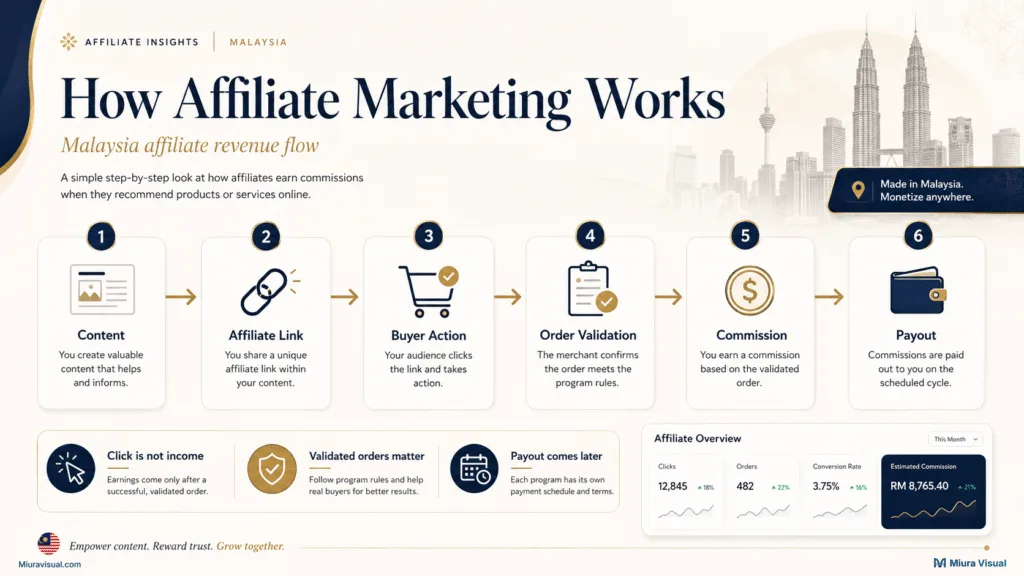
The basic flow is:
Content → Affiliate link → Buyer action → Order validation → Commission → Payout
You do not usually manage:
- Product inventory
- Payment collection
- Packaging and delivery
- Returns and customer service
The business or marketplace handles those responsibilities.
Your job is to bring a relevant buyer to the offer.
You earn a commission only when the buyer completes an eligible action under the programme’s rules
That distinction matters because a click is not income.
An order may still be cancelled, refunded, assigned to another publisher or rejected during validation.
Treat dashboard estimates as pending results until the commission becomes confirmed or payable.
Can You Start Without Stock, a Website or Followers?
You do not need to operate a traditional e-commerce store.
However, removing inventory and logistics doesn’t get rid of the need for traffic.
It also doesn’t eliminate the need for content and product judgment.
| You may not need | You still need |
|---|---|
| Products stored at home | A product category you understand |
| Your own checkout system | An approved traffic channel |
| A large social following | Useful, discoverable content |
| A warehouse or delivery process | A valid tracked link |
| Customer service staff | Clear affiliate disclosure |
| A large startup budget | Time to research and publish |
The better question is not whether you have stock.
Ask whether you have a realistic way to reach potential buyers and help them decide.
You have social media but few followers
You can start building product-led content before you have a large audience.
For example, a photography creator could make videos about:
- Choosing a phone tripod
- Comparing two microphone types
- Setting up a compact lighting kit
- Avoiding common camera accessory mistakes
The account still needs enough public activity for the affiliate programme to review.
Programme approval and sales are separate matters.
👉 For a marketplace example, check the current Shopee affiliate requirements. Don’t just assume that follower count is the only factor.
Affiliate Marketing Without a Website
A website is not compulsory for every programme.
Depending on the platform’s rules, you may promote through:
- TikTok
- YouTube
- Messaging or community channels
- Other approved publishing platforms
The trade-off is platform dependency.
A social account can grow quickly, but a change in the algorithm might limit your reach.
A small website grows slowly.
However, helpful comparisons and tutorials draw in search traffic.
This happens even after they are published.
Affiliate Marketing Without Followers
Followers are one source of traffic, not the only source.
A new affiliate marketer can create:
- Product comparisons
- Buying guides
- Setup tutorials
- Troubleshooting articles
- Product-category explainers
A small website should not rush to cover hundreds of products.
Focus on a specific problem where you can give a better answer than what’s found in a marketplace listing.
How We Separate First-Hand and Researched Affiliate Content
Not every affiliate recommendation has the same evidence backing it.
At Miura Visual, we separate affiliate content into three types:
1. Hands-on content
We have bought, borrowed, received or directly used the product.
This lets us show the product, explain how it works, and share our experiences.
2. Research-based content
We have not personally tested the product.
Instead, we compare specifications, pricing, published information, customer feedback and relevant use cases.
We do not present this type of research as personal experience.
3. Curated recommendations
We choose products based on a buyer’s specific problem.
We also explain how we selected them.
The purpose is not to make every article sound like a personal review.
It is to make the evidence behind each recommendation clear.
A researched article can still be useful.
The problem arises when information from other sources is shown as if it’s from direct testing.
What Our Early Affiliate Content Got Wrong
We used to explain programs and requirements in our affiliate content. We also covered links and how to earn commissions.
The information might help, but we found a flaw. Much of it is also in marketplace docs, affiliate pages, or other sites.
That changed how we think about affiliate content.
We now ask a simple question before developing an article:
If we removed the affiliate link, would the content still be worth reading?
If the answer is no, the article may rely too much on the product or commission chance.
A strong affiliate article helps readers understand a problem. It lets them compare options. It helps them avoid mistakes and make better decisions. This is true even If they don’t click the tracked link.
Our new affiliate content starts with the buyer’s problem. It doesn’t begin with the program or product catalog.
How Miura Visual Approaches Affiliate Content Today
Our current affiliate marketing strategy starts with usefulness before monetisation.
Instead of:
Find product → Get tracked link → Create content → Hope for sales
we prefer:
Buyer problem → Useful content → Relevant product → Tracked action → Result → Next decision
The difference looks small, but it changes what we publish.
Starting with the product encourages us to find reasons to promote something.
Starting with the problem forces us to ask whether the product actually belongs in the content.
For example, if the problem is unstable phone video, we can first explain why the footage is shaky, compare possible solutions and then introduce a tripod or stabiliser where it naturally helps the decision.
The tracked link becomes the next step in useful content instead of the reason the content exists.
We also prefer testing one clear product problem at a time. This makes it easier to understand whether the content, product or traffic source is responsible for the result.
Choose Your Affiliate Starting Route Before the Programme
A common mistake is picking a program just because it’s popular or the commission seems good.
Choose how you will reach buyers first.
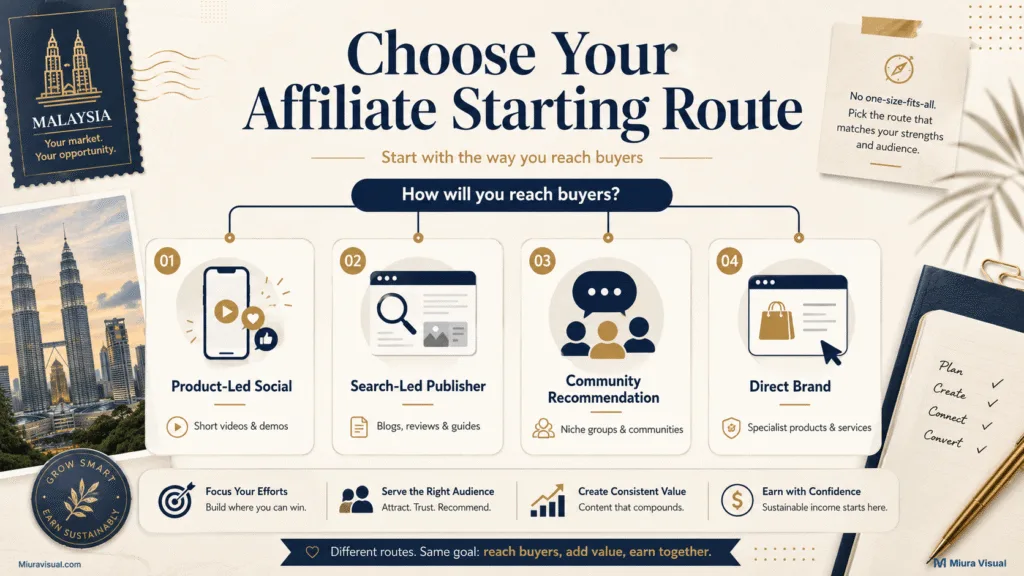
Product-led social route
Prioritise this route when you can make:
- Short demonstrations
- Before-and-after content
- Product problem videos
- Quick comparisons
- Live product explanations
TikTok, Instagram Reels, and YouTube Shorts work well here. The product is easy to understand visually.
The route isn’t as good if the buyer needs detailed technical info before buying.
Search-led publisher route
Use this route when you are comfortable writing or producing detailed videos.
Suitable content includes:
- Product A vs Product B
- Best option for a specific use
- How to choose the right model
- Setup and troubleshooting guides
- Product alternatives
This route fits blogs, content websites and long-form YouTube channels.
Search-led content often takes longer to gain traffic.
However, it can connect with buyers who are already comparing options.
This is better than just relying on brief moments of social media attention.
Community recommendation route
This route works best if you’re in a focused community.
In such groups, members often seek product suggestions.
Examples include communities around:
- Photography
- Gaming
- Parenting
- Home organisation
- Beauty
- Fitness
- Small business tools
Avoid dropping links without context.
Explain why the product is relevant, who it suits and any important limitations.
You should check if the affiliate program and community allow that promotion method.
Direct brand route
A direct brand program is helpful.
It’s best when your content focuses on a specific product or service.
Examples may include:
- Software
- Web hosting
- Travel services
- Creator tools
- Professional equipment
- Online business services
This route can offer stronger topic relevance than a general marketplace.
The downside is a narrower product range.
You may also need more specialised content before readers trust the recommendation.
Where to Find Affiliate Programs in Malaysia
Affiliate opportunities generally come from four places.
| Programme type | Common examples | Best suited to |
|---|---|---|
| Marketplace affiliate | Shopee Affiliate, Lazada Affiliate | Creators covering general consumer products |
| Social-commerce affiliate | TikTok Shop Affiliate | Short-video and live-content creators |
| Affiliate network | Involve Asia, ACCESSTRADE | Publishers who want access to multiple advertisers |
| Direct brand programme | Software, travel, hosting or specialist brands | Creators with a focused niche |
Use the table to choose where to search, not to decide which platform is automatically best.
Shopee Affiliate Program and Lazada Affiliate Program
Marketplace programmes provide access to many products within one shopping platform.
They are useful for:
- Everyday product recommendations
- Deal content
- Comparison articles
- Product demonstrations
- Buying guides
The Shopee Affiliate Malaysia is a familiar marketplace option for Malaysian creators.
It helps them promote Shopee products available through the marketplace.
Lazada provides another marketplace route.
A creator may use both later.
However, joining them now can make early tracking harder.
Start with one platform if your traffic is still limited.
Add another when you understand which products and content formats generate useful actions.
TikTok Shop Affiliate Program
TikTok Shop combines content discovery and shopping within the same ecosystem.
It may suit creators who can consistently produce:
- Product demonstrations
- Short reviews
- Live content
- Problem-and-solution videos
- Visually clear product recommendations
This route may not suit people who dislike short, frequent tasks or rely on detailed writing.
Affiliate Networks in Malaysia
Networks such as Involve Asia and ACCESSTRADE connect publishers with different advertisers.
The main benefit is convenience.
You can find many offers in one publisher account.
This saves you from searching each brand separately.
However, network approval does not always mean offer approval.
An advertiser may still review your channel, topic, audience or promotional method.
Networks are more useful after you know your niche.
Joining one without a clear topic can leave you with many offers but no sensible reason to promote them.
Direct Brand Affiliate Programs
Search the websites of products you already use or regularly discuss.
Look for footer links or pages named:
- Affiliates and partners
- Referral programme
- Publisher programme
- Ambassador programme
You can also search for the brand name followed by “affiliate programme”.
Do not force a direct programme into your content simply because it pays more.
The product still needs to fit your target audience’s problems.
How to Choose an Affiliate Program in Malaysia
You do not need a complicated score for every programme.
Use a red-flag filter and remove weak options first.
Skip programmes with poor audience fit
A high affiliate commission rate cannot compensate for an irrelevant product.
A photography audience may respond to editing software, storage, lighting or camera accessories.
The same audience might skip fashion or household ads.
This could happen even if the commission rate is higher.
Check whether your channel is allowed
Some programmes accept blogs, social accounts and video channels.
Others may restrict certain promotional methods.
Check:
- Accepted platforms
- Link-sharing rules
- Paid advertising restrictions
- Coupon or deal promotion rules
- Messaging-channel policies
- Content and brand guidelines
Do this before building content around the offer.
Avoid unclear tracking and validation
A useful programme should explain its commission structure, including:
- Tracked clicks
- Order attribution
- Cancelled or refunded transactions
- Commission validation
- Payment thresholds
- Payout methods
If you don’t know when a commission is paid, don’t trust the dashboard’s earliest estimate.
It might mislead your income expectations.
Compare Commission Rate and Payout Practicality
A programme may look attractive but still be unsuitable for a small content website if:
- The payout threshold is difficult to reach
- The payment method is inconvenient
- Validation takes longer than expected
- Important account details are unclear
- Support is difficult to access
Higher commission is not always better.
A low-rate offer that connects well can earn more than a pricey product that sits unsold.
Check whether you can create responsible content
Skip the programme when the products require claims or expertise you cannot support.
This is especially important for products involving health, finance or specialised technical performance.
The safer choice is to promote products.
You should clearly explain their use and limits.
Also, make the buyer’s decision easy to understand.
How to Start Affiliate Marketing in Malaysia With One Buyer Problem
Do not begin by collecting links.
Build one complete affiliate path:
One buyer problem → One product type → One channel → Three useful content pieces → One tracked link
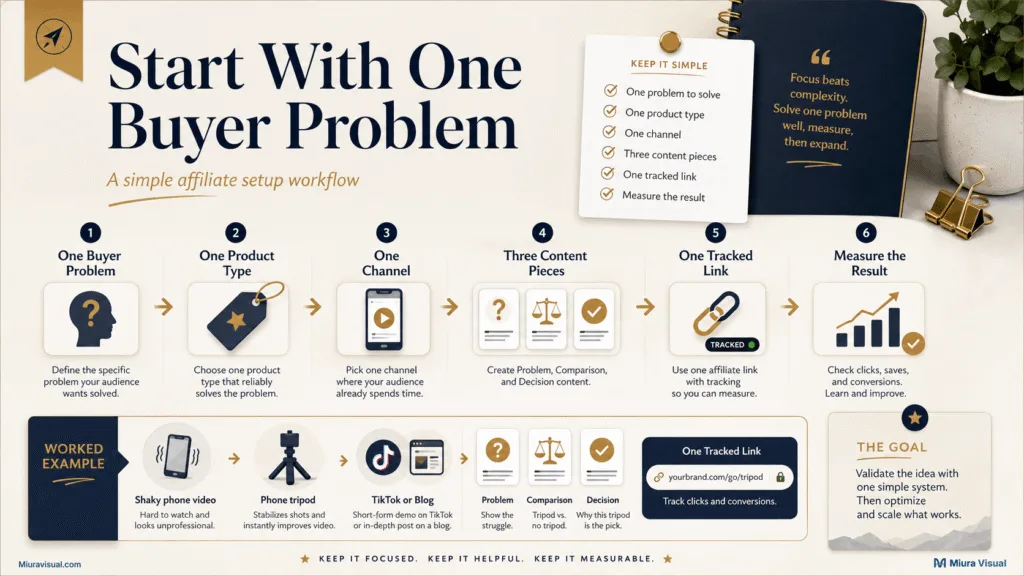
Step 1: Choose one buyer problem
Look for a question that can lead to a product decision.
Examples:
- My phone videos are unstable.
- My room lighting looks flat on camera.
- I need a simple microphone for talking videos.
- I want affordable storage for large media files.
- I need a compact tripod for travel.
Avoid starting with a broad category such as “electronics”.
A clear problem gives your content direction.
Step 2: Choose One Product Category
Match one product type to the problem.
For example:
Buyer problem: Phone videos look unstable
Product type: Phone tripod or stabiliser
Do not promote tripods, lights, microphones, bags and power banks in the same first test.
A narrow product type makes your clicks and content feedback easier to understand.
Step 3: Select one traffic channel
Choose the channel that fits both your ability and the product decision.
- Use short video when the benefit is visually obvious.
- Use a blog when the buyer needs comparisons or detailed reasoning.
- Use YouTube when setup and performance need demonstration.
- Use a community when the question already appears naturally there.
A creator with strong editing skills should not choose a short-form platform if the workload prevents regular publishing.
If they have a heavy workload, they can’t publish regularly.
A small website should not chase short-video trends simply because they appear faster.
Search-led content may be slower but better aligned with its existing strengths.
Step 4: Create three decision-stage content pieces
Create different content for different buyer questions:
- Problem content
Explain why the issue happens and what type of product may solve it. - Comparison content
Compare two product types, features or price levels. - Decision content
Help the buyer choose, set up or use the product correctly.
For the phone-stability example:
- Why handheld phone videos look shaky
- Tripod vs handheld stabiliser
- How to choose a compact phone tripod
These pieces support one another instead of promoting unrelated products.
Step 5: Add one clear affiliate action
Place the tracked link where the reader naturally needs the next step.
Include:
- A clear affiliate disclosure
- One main recommendation or selection
- A reason to click
- A tracked link generated through the correct programme
- A source label or Sub ID when available
When using Shopee, follow the proper process to generate an affiliate link instead of assuming a normal product URL will track.
Step 6: Track the commercial result
Do not judge the content only by views or likes.
Record:
- Content topic
- Product type
- Traffic channel
- Link or tracking label
- Clicks
- Orders
- Validated commission
- Next action
The result should tell you what to change.
For example:
- Views but no clicks may indicate weak buying intent.
- Clicks but no orders may indicate poor product fit.
- Orders but no confirmed commission may indicate a validation or attribution issue.
How We Read Affiliate Performance at Miura Visual
We do not treat views, clicks, orders and commission as the same result.
Each stage tells us something different.
Views but few clicks
The content may attract attention without creating enough buying intent.
We first check if the recommendation is relevant.
Then, we see if the next step is clear before changing the product.
Clicks but few orders
The content has created interest, so we look further down the path.
Things like price, reviews, and shipping costs might stop the purchase. Product options or fit could also be issues.
Producing more content does not automatically solve this problem.
Orders but no validated commission
We do not count the order as confirmed affiliate revenue yet.
Cancellation, refunds, attribution, product eligibility or tracking can still affect the final commission.
Validated commission
This is a stronger commercial signal.
The content has gone beyond just grabbing attention and clicks.
It has led to eligible transactions.
Even then, one sale is not enough evidence to scale an entire content category.
We seek repeatable patterns in content topics, products, and traffic sources.
Then, we decide what needs more effort.
This is also why we track the stages separately:
Content → Click → Order → Validation → Commission → Payout
Knowing where the path breaks is more helpful than just knowing the view count of a piece of content.
Where Affiliate Income Breaks Between Click and Payout
Affiliate income can fail at several different points.
Fixing the wrong stage wastes time.
| Programme type | Common examples | Best suited to |
|---|---|---|
| Marketplace affiliate | Shopee Affiliate, Lazada Affiliate | Creators covering general consumer products |
| Social-commerce affiliate | TikTok Shop Affiliate | Short-video and live-content creators |
| Affiliate network | Involve Asia, ACCESSTRADE | Publishers who want access to multiple advertisers |
| Direct brand programme | Software, travel, hosting or specialist brands | Creators with a focused niche |
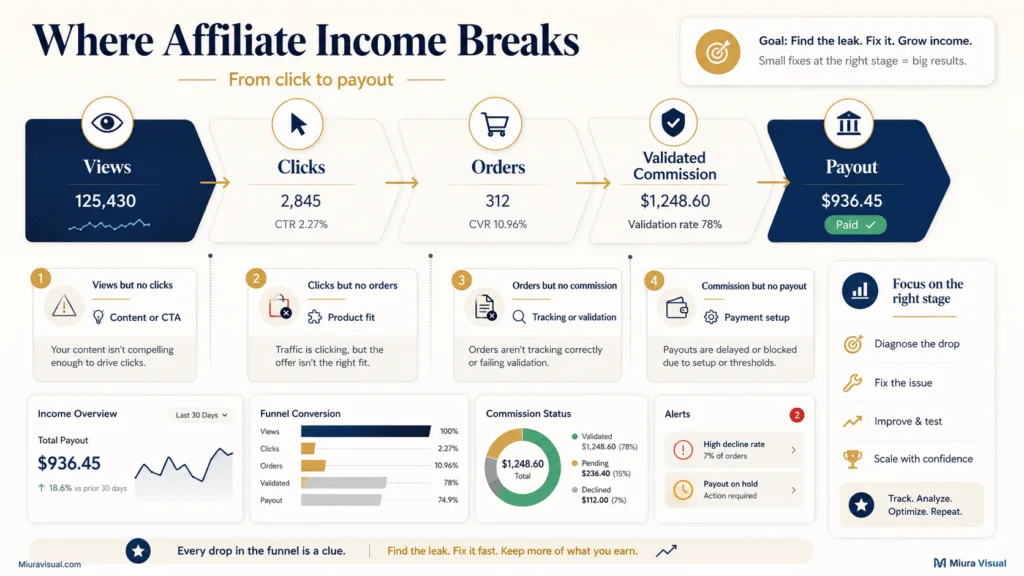
Views but no clicks
The content may be interesting without helping a purchase decision.
A funny product video can earn views but produce little commercial action.
A smaller comparison may attract fewer viewers but stronger clicks.
Check whether the content answers:
- Who is the product for?
- What problem does it solve?
- Why should someone choose it?
- What limitation should the buyer know?
- What should the buyer do next?
Clicks but no orders
Do not assume the link is broken immediately.
The reader might have clicked out of curiosity but chose not to buy after seeing:
- The price
- Weak reviews
- High delivery cost
- Poor product images
- A stronger alternative
- A confusing product variation
The better correction may be changing the product, not producing more content.
Orders but no commission
An order is not necessarily an approved commission.
Possible reasons include:
- The order was cancelled
- The buyer requested a refund
- The product was ineligible
- Another affiliate received the final attribution
- The tracked link was incorrect
- The report has not updated
👉 For Shopee tracking issues, check the affiliate link troubleshooting guide. Don’t just change links without reviewing the reports first.
Affiliate Commission but No Payout
A commission may still be pending validation or waiting for the payment cycle.
Check:
- Commission status
- Minimum threshold
- Payment and tax information
- Bank details
- Account restrictions
- Scheduled payout date
The Shopee affiliate payout guide explains the payment stages in detail.
The main rule is simple: do not treat pending commission as cash received.
When Affiliate Marketing Is Not the Right Low-Cost Route
Affiliate marketing is worth considering if you can drive traffic to relevant products without taking on inventory risk.
It should not automatically be your first income priority.
Prioritise affiliate marketing when you have:
- A clear product-related topic
- An existing traffic or publishing channel
- Repeated product questions from your audience
- The ability to create useful decision content
- Enough time to wait for traffic, validation and payout
- A willingness to track results
Build first when you have:
- No clear niche
- An empty or private content account
- No searchable website content
- No product understanding
- No consistent way to reach people
- Frequent topic changes
In that case, choose one topic.
Build a distribution channel for it.
Then, apply to several programs.
Skip or delay affiliate marketing when you:
- Need predictable cash immediately
- Do not want to create product-related content
- Only plan to send links to friends
- Expect fully passive income
- Refuse to disclose affiliate relationships
- Do not want to review programme rules
- Cannot explain why a product suits the buyer
- Have a marketable service that could generate faster income
A photographer who needs quick cash should sell one specific service.
They can choose photography or editing.
This can help bring in income faster.
A content publisher with more traffic related to products can likely add affiliate links.
If affiliate marketing doesn’t fit your current assets, consider a broader guide.
Choose a monetisation path that works for you.
Don’t force every content channel into product promotion.
Conclusion: Build One Trackable Affiliate Path First
Start now when you already have a focused topic, a usable traffic channel and one buyer problem you can explain clearly.
Wait when you have no distribution method or urgently need predictable income.
Creating a simple content plan or focusing on a service can provide a clearer starting point.
Your next step is not to register for every available programme.
Select a starting route.
Pick one relevant program.
Then, create three pieces of content about one product decision.
Then use clicks, orders and validated commission to decide what deserves more effort.
Frequently Asked Questions
Can I join more than one affiliate programme in Malaysia?
Yes, but beginners should start with one programme. Too many dashboards and overlapping links make it tough to see what’s working.
Do I need to buy every product I promote?
No. However, you must not present research as personal testing. Clearly distinguish hands-on reviews from researched comparisons and curated recommendations.
Is affiliate marketing passive income?
Not at the beginning. Content research, publishing, link maintenance and performance tracking require ongoing work. Older content can still earn money, but it needs relevant traffic and valid offers.
How long does affiliate marketing take to generate income?
There is no fixed timeline. Results depend on existing traffic, buyer intent, product fit, content quality, programme approval and commission validation.
Should I choose the programme with the highest commission?
Not by default. Prioritise audience relevance, conversion potential, tracking clarity and payout practicality. A high rate has little value when the product does not sell.

Miura Visual
Transforming visuals into content, stories, and scalable value across platforms and audiences.
Related Article