How to Become a Freelance Content Creator in Malaysia
This freelance content creator Malaysia guide shows you how to turn your creative skill into a clear service, price your work, and decide if freelancing fits your income goals. You’ll learn to define your offer, price your services, and see if freelance work fits your income goals.

Quick Answer
Yes, you can start freelance content creation in Malaysia without a large following.
Freelancing works best if you have a strong skill and want to earn from it.
Photography, videography, video editing, retouching, design, and social content production can all become freelance services.
Start with one clear offer:
Skill → Client problem → Deliverable → Scope → Price
Do not begin by selling every creative skill you have.
👉 If you’re not sure about client work as your income path, look at other creator income paths in Malaysia first.
Freelance Content Creator Malaysia: Freelance Job or Freelance Service?
The phrase “freelance content creator” can describe two different situations.
| Path | How it usually works | Main responsibility |
|---|---|---|
| Freelance or contract role | A company defines the role, workload, schedule, or monthly arrangement | Complete the assigned work |
| Independent freelance service | You define the service, scope, quotation, workflow, and delivery | Find and manage your own clients |
This guide focuses on the second path.
An independent freelancer is not simply looking for a content creator job.
You are building a small service around something you can already do.
That distinction matters because the next steps are different.
If you want a contract role, focus on applications, experience, and job fit.
If you want your own freelance service, focus on:
- What you sell
- Who needs it
- What the client receives
- What is included
- How you price the work
- How you manage the project
Decision rule: If you want clients to buy results from you, view freelancing as a service. It’s more than just a job title.
Turn One Creative Skill Into a Service Clients Can Buy
Knowing many skills can help you deliver projects.
It does not mean you should sell all of them at once.
“Photography, video, editing, design, social media, and content creation” describes your abilities.
It does not describe a clear offer.
A client needs to understand what problem you solve and what they will receive.
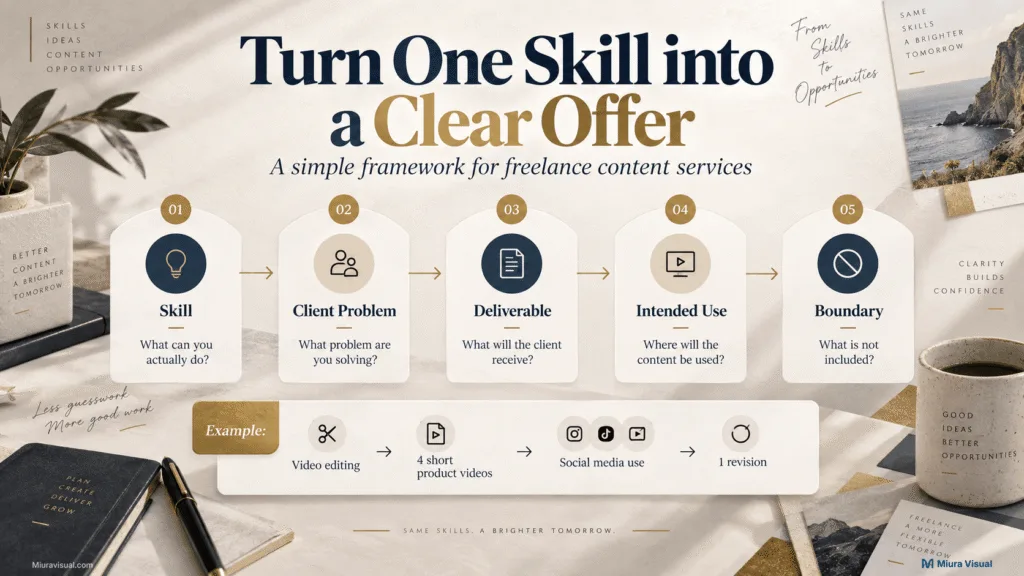
A simple way to structure the offer is:
Skill → Client problem → Deliverable → Intended use → Boundary
Example:
Video editing → client already has product footage → four vertical videos → Instagram and TikTok → captions, basic graphics, one revision round.
It’s clearer than just saying, “I offer video editing and creative services.”
The same logic can apply to different creative skills.
Photography
❌ Instead of simply saying “Freelance photographer available,” make the offer more specific.
✅ Better: Product photography for online listings, including selected edited images in agreed formats.
Social Media Video
❌ Instead of saying “I shoot videos,” explain what the client will receive.
✅ Better: Short product demonstration videos prepared for social media use.
Editing
❌ Instead of saying “Professional video editing,” specify what you will deliver.
✅ Better: Edit the footage into short videos for the platform. Add captions and graphics. Make any needed revisions.
Miura Visual uses this same separation across its visual content services.
Photography, video production, retouching, and editing can work well together.
But each service needs a clear scope.
Build your first offer
Write down five things:
- Who is the service for?
- What problem are they trying to solve?
- What will you deliver?
- Where will the content be used?
- What is not included?
If you cannot answer those questions clearly, do not worry about your freelance rate yet.
Fix the offer first.
How Should You Price Freelance Content Creation?
Do not start by asking, “What is the normal freelance content creator rate in Malaysia?”
Start with a more useful question: “What exactly am I being asked to deliver?”
A single number means very little without scope.
A RM300 video could mean:
- Editing supplied footage
- Planning and filming from scratch
- One short video
- Several cut-down versions
- Basic captions
- Motion graphics
- One revision
- Unlimited revisions
- Organic social use
- Paid advertising use
Those are not the same job.

Scope first, price second
Before quoting, confirm the main cost drivers.
At Miura Visual, the current quotation process considers factors such as:
- Project scope
- Shoot duration
- Editing requirements
- Number of deliverables
- Location
- Equipment
- Crew
- Studio requirements
- Intended usage
The same principle is useful for an independent freelancer.
Use This Freelancer Pricing Checklist
Before sending a price, confirm:
Deliverables
- What are you actually producing?
- How many final files?
- What length, format, or resolution?
Production
- Is shooting required?
- How long will production take?
- Is travel involved?
- Do you need special equipment?
Post-production
- How much editing is required?
- Are subtitles, graphics, retouching, or audio work included?
Revisions
- How many rounds are included?
- What counts as a revision?
- What happens if the direction changes?
Timeline
- What is the deadline?
- Is the client asking for rush delivery?
Usage
- Social media only?
- Website?
- Marketplace listing?
- Paid ads?
- Print?
Extra costs
- Studio
- Transport
- Props
- Assistants
- Talent
- Licensed assets
- Equipment rental
Once those details are clear, you can choose how to price the project.
That may be:
- A project fee
- A day or session rate
- A per-deliverable rate
- A package
- A recurring monthly arrangement
There is no need to force every freelance job into an hourly rate.
Mistake to avoid: copying someone else’s rate without comparing their scope to yours.
Two creators can set different prices for similar “videos.”
This is because the effort and work behind each one vary.
Build a Strong Portfolio That Proves the Service
A freelance portfolio should prove what you can deliver.
It should not become a storage page for every creative thing you have ever made.
To sell product photography, your portfolio must showcase your work quickly.
If you want to sell short-form editing, clients should see finished short-form edits.
To sell retouching, use before-and-after examples.
They work better than random portraits.
A strong portfolio usually answers three questions:
- What do you do?
- What does the finished work look like?
- Can you handle the kind of project I need?
Organise proof around the service
A simple project presentation can include:
- Project type – Product photography
- Purpose – Images for an e-commerce listing
- Deliverables – Selected edited product images
- Final work – The completed visuals
You do not need a long case study for every project.
You need enough context for the client to understand why the work is relevant.
Miura Visual organizes its portfolio by separating various types of visual and digital work. This way, everything isn’t mixed into one gallery.
What if you have no client portfolio yet?
Create proof for the service you want to sell.
For example, if you want product video work:
- Choose a product you already own.
- Create a realistic brief.
- Produce the deliverable as if it were a client project.
- Present the finished result clearly.
- Label it as a personal or practice project when appropriate.
Do not invent a client or business result.
The goal is to prove production ability.
How Do You Find Your First Freelance Clients in Malaysia?
Do not wait for clients to find and hire you.
Start where there is already a clear need for your skill.
A practical order is:
1. Start with people already close to your network
Friends, business contacts, previous colleagues, creators, studios, and small businesses may already know what you can do.
Do not simply announce “I am freelancing now.”
Tell people what you actually offer.
Example: I’m working on short videos for brands. They have products but need social media content ready to post.
A clear offer is easier to remember and refer.
2. Look for a visible business problem
Do not send the same message to 100 businesses.
Look for something specific.
For example:
- Product page has weak visuals
- Business has no short product demonstration
- Social videos are inconsistent
- Brand already records content but needs editing support
- Website has outdated team or service photos
Then pitch the relevant service.
Avoid a vague message like “Hi, I am a freelance content creator. Do you need content?”
Make the message about a real business need.
✅ Better: I noticed your product page mainly uses static images. I make short product demo videos. You can use them on social media and product pages.
The second message gives the business something concrete to consider.
3. Ask for referrals after suitable work
A previous contact does not need another project to become useful.
They may know someone else who does.
Make the referral easy by explaining your current offer clearly.
4. Use job boards and marketplaces as one source, not the whole strategy
Freelance job listings and marketplaces can expose you to real demand.
They can also be competitive and price-sensitive.
Use them to:
- See what businesses are asking for
- Learn common deliverables
- Identify recurring problems
- Apply when the job details and scope fit
Do not build your entire freelance business around constantly chasing listings.
A stronger long-term position comes from having your own portfolio.
It also includes your own offer and inquiry path.
Use a Simple Client Workflow From Enquiry to Delivery
Finding a client is only the start.
A weak workflow creates confusion even when your creative work is good.
Miura Visual uses a staged production process.
It separates scope, quotation, preparation, production, review, and delivery.
Freelancers can use the same basic logic.
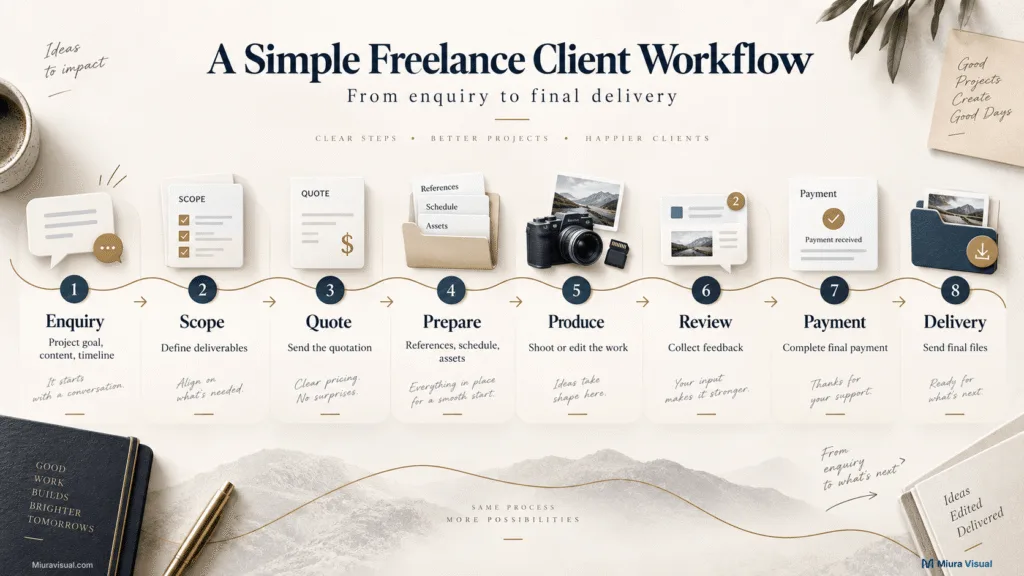
Step 1: Enquiry
Ask what the client needs.
Collect the basics:
- Project goal
- Required content
- Quantity
- Intended platform
- Timeline
- Location
- References
Do not quote from “I need some videos” alone.
Step 2: Confirm the scope
Turn the request into actual deliverables.
For example:
Four vertical videos, each up to 30 seconds long. They are filmed in one location. Basic editing is included, along with one round of revisions.
Now both sides know what the project means.
Step 3: Send the quotation
The quotation should match the confirmed scope.
Include any important exclusions or additional costs.
If the client changes the scope later, update the quote.
Don’t just take on the extra work without addressing it.
Step 4: Prepare the project
Depending on the job, preparation may include:
- Shot list
- Product list
- References
- Location
- Schedule
- Props
- Script or talking points
- File collection
Preparation prevents avoidable problems during production.
Step 5: Produce or edit
Complete the agreed work.
Do not keep adding deliverables because you think the client might like them.
Deliver what was sold first.
Step 6: Client review
Send the draft or preview through the agreed review process.
Keep feedback within the confirmed revision scope.
Step 7: Final payment and delivery
Once the project is approved and the payment terms are met, deliver the final files in the agreed format.
This workflow is simple on purpose.
You do not need a complicated agency system to start freelancing.
You need clear checkpoints.
Protect Your Time From Scope Creep
Scope creep happens when a project slowly becomes bigger without the price changing.
One extra request may look harmless.
Ten extra requests are not.
Common examples include:
- “Can you make another version?”
- “Can we try a new concept?”
- “Can you also resize everything?”
- “Can you send the RAW files?”
- “Can I have the editable file?”
- “Can we do one more revision?”
- “Can you deliver tomorrow instead?”
- “Can you also shoot a few photos?”
The solution is not to reject every small change.
The solution is to decide what is included before the project begins.
At Miura Visual, current service scopes separate included revisions from additional revisions.
Extra versions and editable project files may need separate quotes.
So do licensed assets and other added needs.
A freelancer can apply the same boundary.
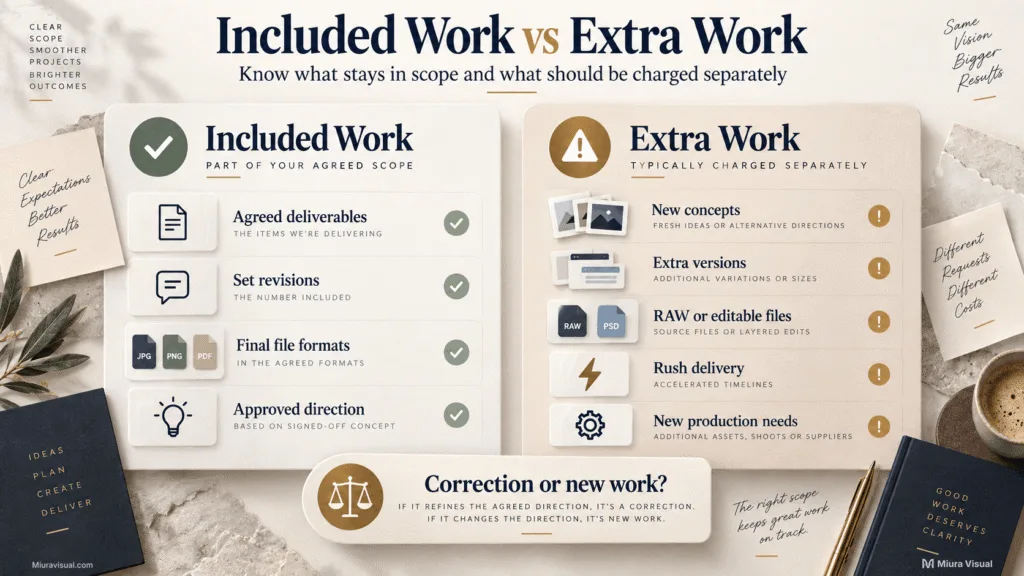
Define these before starting
- Number of deliverables
- Number of revisions
- Final file formats
- Whether source or editable files are included
- Turnaround time
- Additional version pricing
- Third-party costs
- Rush work
- Changes to the original direction
A useful decision rule
Ask yourself: Is this a correction within the agreed direction, or is this new work?
A correction may belong inside the revision scope.
A new deliverable, new concept, or new production requirement usually does not.
Do not use “unlimited revisions” to make your offer look attractive.
Unlimited work creates unclear responsibility for both sides.
Is the Project Actually Worth the Money?
A project fee is not the same as useful income.
Before deciding, check what the project needed.
Then, decide if freelance content creation is worth it.
Start with:
Project fee − direct project costs = project income
Then look at the time involved.
Count more than shooting or editing.
Actual project time may include:
- Enquiry
- Calls and messages
- Planning
- Travel
- Setup
- Production
- File organisation
- Editing
- Revisions
- Exporting
- Delivery
- Admin
Then calculate:
Project income ÷ total project hours = effective hourly return
This number does not mean every future project must be charged hourly.
It helps you see whether the current price and scope make sense.

Example
Imagine a creator charges RM1,000 for a project.
The headline number sounds reasonable.
But the project also requires:
- RM120 transport
- RM150 studio cost
- Several hours of planning
- One day of production
- Two evenings of editing
- Multiple revision rounds
The useful question is not “Did I earn RM1,000?”
A better question is: “What remained after the project costs and time?”
That answer helps you decide what to change.
You might need to:
- Increase the fee
- Reduce included deliverables
- Limit revisions
- Charge third-party costs separately
- Improve the workflow
- Stop accepting that project type
Higher revenue is not always better freelance work.
A smaller project with a clean scope may be more useful than a larger project that takes several days.
When Should You Keep Freelancing, Raise Rates or Add Another Income Stream?
Freelancing is useful when your skill can create income now.
It does not need to remain your only income source forever.
Keep the current model when:
- The projects fit your skill
- Clients understand the offer
- Scope stays manageable
- The effective return is acceptable
- You still have enough production capacity
There is no need to complicate something that is working.
Improve the offer or raise rates when:
- Demand is becoming consistent
- Your portfolio is stronger
- Projects are taking more time than expected
- Your scope has become clearer
- Clients repeatedly request the same service
A higher rate works better when the offer itself has improved.
Do not raise prices only because another creator charges more.
Specialise when:
- One service performs better than the rest
- You are developing deeper expertise
- Better-fit clients keep asking for similar work
- Specialisation makes delivery more efficient
You can still have other skills.
The difference is that the market understands what you are known for.
Add another monetisation path when client work is using all your time
Freelance services exchange production capacity for income.
That can become limiting when every extra Ringgit requires another project.
If you’re building traffic or an audience, that’s great.
You can add content later that isn’t tied to client hours.
For example, affiliate marketing in Malaysia works well if your content helps people pick tools or products.
Creators with audience access can try brand collaboration models.
These partnerships offer promotion and production.
They also add value.
Do not add a second income stream because freelancing sounds less exciting.
Add one when you have the time, audience, traffic, or demand needed to support it.
Conclusion
If you already have a useful creative skill, start by turning one skill into one clear service.
Define the deliverable. Scope it well.
Then, build proof and test the offer with real client opportunities.
If you can’t explain what the client is buying, take a step back.
Don’t worry about rates or joining more freelance platforms yet.
Fix the offer first.
Once the service is clear, you can take a simple next step: write the scope.
Then, prepare two or three relevant portfolio examples.
After that, start reaching out to people who already have the problem you can solve.
Frequently Asked Questions
Do I need followers to become a freelance content creator in Malaysia?
No. A client can pay for your production skill without paying for access to your audience.
Followers matter more when the deal includes promotion, sponsorship, or audience reach.
Is a freelance content creator the same as a UGC creator?
Not exactly.
UGC creation is one form of content production, usually created for a brand to publish or use. Freelance content creation covers many areas. It includes photography, video, editing, design, and social content. Other creative services may also be part of it.
Do freelance content creators need their own equipment?
It depends on the service.
A video editor may work entirely with client-supplied footage. A photographer or videographer might need their own gear, rented gear, or a setup agreed upon with the client.
Any rental or third-party production cost should be confirmed before the project starts.

Miura Visual
Transforming visuals into content, stories, and scalable value across platforms and audiences.
Related Article