How to Generate a Shopee Affiliate Link in 5 Steps
Need to create your Shopee affiliate link quickly? This guide shows you how to generate the link, avoid common mistakes, and understand what happens after someone clicks it.

Quick Answer: How to Generate a Shopee Affiliate Link
To create a Shopee affiliate link, log in to your Shopee Affiliate dashboard or app. Then, pick the product you want to promote. Next, generate the link, copy it, and share it on your content platform.
- Log in to your Shopee Affiliate dashboard or app.
- Choose the product you want to promote.
- Generate or convert the affiliate link.
- Copy the generated link.
- Share it on your content platform.
How to generate Shopee affiliate link?
The answer is simple.
Pick a product, create your affiliate link from the Shopee Affiliate dashboard or app, and use that link to promote the product.
That is the basic flow.
Here is the step-by-step process:
| Step | What to do | Common mistake |
|---|---|---|
| 1 | Open the Shopee Affiliate dashboard or app | Using the normal Shopee app without entering the Affiliate tool |
| 2 | Find the product you want to promote | Choosing a random product without a content angle |
| 3 | Generate the affiliate link | Assuming a normal Shopee product URL is already an affiliate link |
| 4 | Copy the generated link | Forgetting to check whether you need Sub ID |
| 5 | Share it on your content platform | Dropping the link without matching it to useful content |
Warning:
- Do not assume a normal Shopee product URL is already your affiliate link.
- Generate or convert the link through the Shopee Affiliate dashboard or app before sharing it.
Generating the link is the easy part.
The next challenge is making sure the link is tracked properly and the order can be credited to you.
That is where most confusion starts.
What is Sub ID and when should you use it?
Sub ID is a tracking label you attach to your affiliate link.
It helps you tell your own traffic apart.
For example, you might promote the same product in different places:
- TikTok video
- Instagram Story
- Blog article
- WhatsApp share
- Facebook post
If all of them use the same raw affiliate link, you may know the total clicks, but not which platform or post actually drove them after you shared the product.
That is where Sub ID becomes useful.
You can use a different Sub ID for each source, such as:
- tiktok1
- igstory1
- blogpost1
- whatsapp1
This makes your tracking cleaner.
When should you use Sub ID?
Use it when:
- You are sharing the same product on multiple platforms
- You want to compare which content performs better
- You are testing hooks, formats, or placements
- You want to build a cleaner affiliate system
If you only promote casually once in a while, Sub ID is optional.
If you want to improve performance over time, it is worth using.
Many beginners ignore Sub ID because it sounds technical.
In reality, it is just a simple way to label your links.
If you share the same product on TikTok, Instagram, and your blog.
Sub ID helps you see which one is actually driving clicks or orders.
Can you generate multiple Shopee affiliate links at once?
Yes, you can.
This matters if you want to promote more than one product or prepare content in batches.
For example:
- one “Top 5 desk setup products” post
- one “best RM20 home items” Reel
- one blog article comparing several products
In cases like these, generating one link at a time becomes slow and annoying.
If you already know what you want to promote, batch generation saves time.
Just because you can create many links doesn’t mean you should share them all at once.
That is a common beginner mistake.
Too many links usually means:
- weak focus
- weaker content
- less clarity for the viewer
- lower conversion
A short list of well-chosen products usually works better than a giant pile of random links.
Which Shopee Affiliate Link Type Should You Generate?
If your content focuses on one product, use a product link.
If you are recommending one seller or store, a shop link makes more sense.
If your content compares or recommends several items, a collection link is usually more useful.
 Not sure which one fits your content?
Read Which Shopee Affiliate Link Type Should You Use?
How does Shopee track clicks and orders?
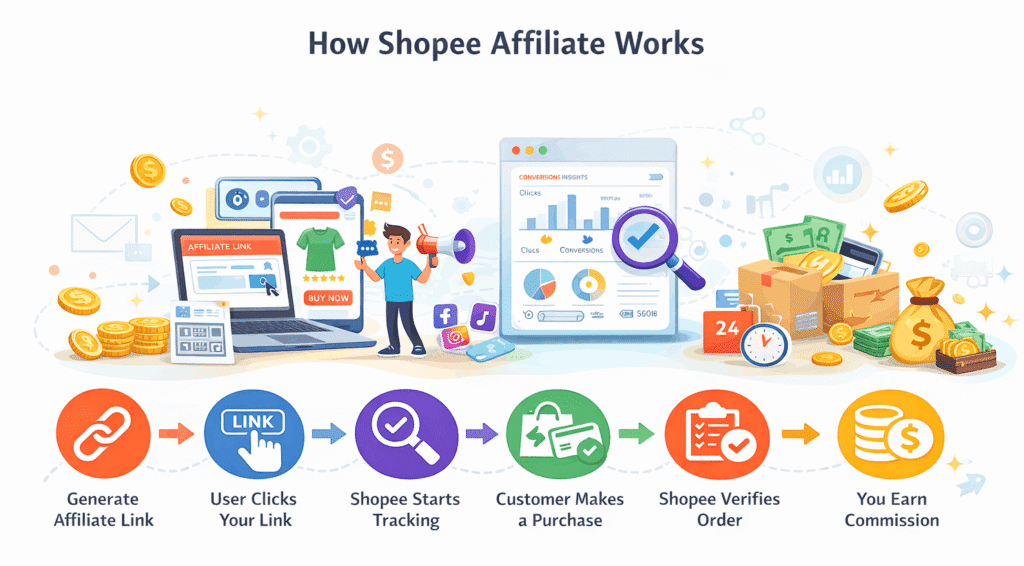
Shopee tracks affiliate sales through your unique affiliate link. When someone clicks your link, Shopee records that click.
If the buyer makes a valid order during the tracking window, and your content was the credited source, the sale could go to you.
That is the basic logic.
But there are two details that matter a lot:
- the click must be tracked properly
- the order must still qualify
This is why “someone clicked my link” does not always mean “I will definitely get commission.”
A simpler way to understand it
Think of the affiliate link like a tag.
When the buyer clicks your link, Shopee places a tracking signal on that journey.
If the buyer makes a valid purchase under the right conditions, Shopee will link that purchase to your link.
That is how the system knows the order came from you.
But that only works if:
- your click was tracked
- no other affiliate overrides the attribution
- the order is valid
- the purchase happens within the allowed time window
So yes, the click matters.
But the click alone is not the final answer.
What does the 7-day tracking window actually mean?
This is one of the most misunderstood parts of Shopee Affiliate.
Many beginners hear “7 days” and think the link only works for 7 days.
That is not the best way to understand it.
The better way is this:
The click has a 7-day attribution window.
If someone clicks your affiliate link, Shopee might still credit you for the order. This happens if the buyer checks out within that time frame.
So the key point is not “the link expires forever in 7 days.”
The key point is:
that specific click only has a limited time to lead to a credited order.
So if the buyer clicks today and buys later?
If they buy within the allowed tracking window, the order may still count.
If they buy too late, it may not count.
Does that mean every order within 7 days is guaranteed?
No. The order still needs to qualify.
That means issues like refunds, cancellations, invalid activity, or attribution loss can still affect whether commission is paid.
This is why Shopee Affiliate is not just about generating a link and waiting for someone to buy later.
The faster your content helps people make a decision, the better your link tends to perform.
If your post only creates weak interest, people may click and leave.
If your content creates clear buying intent, the chance of a tracked order is much stronger.
How can you check clicks, conversions, and orders?
You should not do affiliate blindly.
If you are generating links but never checking performance, you are not building a system.
You are just hoping.
At minimum, you want to know three things:
- how many people clicked
- whether any orders happened
- which content or platform performed best
This is where the Shopee Affiliate dashboard matters.
What should you actually look at?
Focus on these:
What do these numbers really mean?
If you have clicks but no orders, the problem may be:
- weak product choice
- weak buyer intent
- weak content fit
- poor pricing
- poor product page quality
If you have views but no clicks, the problem may be:
- weak CTA
- poor link placement
- poor trust
- unclear recommendation
If one platform gets far better results than another, that matters too.
You do not need huge data to learn. Even a small pattern is useful.
Many beginners ask, “What product should I promote?”
A better question is: Which product is getting clicks?
Which one has good conversion signals from my audience?
That is where the dashboard becomes useful. It helps you look at actual behavior instead of guessing based on what seems popular.
What mistakes can stop your tracking or reduce your commission?
This is where many beginners lose money without realizing it.
The biggest mistake is thinking affiliate tracking is automatic and foolproof.
It is not.
Small mistakes can reduce tracking quality or reduce what you finally earn.
Here are the most common ones.
1. Sharing the wrong link
Not every link is equally useful.
If you promote the wrong page type, tracking or earning potential may not be as strong as you think.
Product-focused affiliate links work better. They are more effective than random broad links.
2. Not understanding attribution
If the buyer clicks a different affiliate’s link later, your earlier click won’t get credit.
Some affiliates say, “Shopee never paid me.” But the real issue is that the credited path changed.
3. Waiting too long between click and purchase
If the buyer delays too much, the order may fall outside the eligible tracking window.
Again, this is why strong buying intent matters.
4. Ignoring order quality
Cancelled, refunded, or invalid orders may not become payable commission.
So even if you see activity, it does not always mean the payout is secure.
Where can you share your affiliate link or code?
You can usually promote your affiliate link through platforms like:
- TikTok
- blog or website
- messaging channels
- other content platforms
The better question is not just “where can I share it?”
The better question is:
Where does the content naturally lead to a click?
That matters more.
If a platform has trouble with external URLs, sharing affiliate codes is usually better.
For this article, that is enough to know.
The deeper strategy side can be discussed separately.
Generated your link? The next step is choosing where to share it so people actually click. Read: How to Share Shopee Affiliate Links on Social Media Platforms
Related Guides
What most beginners get wrong about Shopee affiliate links
Most people think this process is:
generate link → share link → get commission
That is too simple.
But, the real process is closer to this:
Generate the right link → Place it well → Get the click → Hold attribution → Trigger a valid order → Wait for that order to qualify.
That is why affiliate results often feel slower than expected.
The link is only the first step. Tracking, buyer intent, and valid order behavior decide the rest.
A good affiliate setup is not about sharing more links. It is about making the buying decision easier.
The easier it is to understand the product, trust the recommendation, and buy in time, the better the system works.
Conclusion
Generating a Shopee affiliate link is easy.
Understanding how that link turns into a credited order is the real skill.
If you want your affiliate system to work, focus on these basics:
- generate the right link
- use Sub ID when you need cleaner tracking
- understand how click attribution works
- know what the 7-day window actually means
- check your clicks, conversions, and orders
- avoid mistakes that break trust, delay buying, or weaken attribution
If you understand these, you are already ahead of many beginners.
Because most people are not losing at affiliate because they cannot generate a link.
They are losing because they do not understand what happens after the click.
Frequently Asked Questions
How do you generate a Shopee affiliate link?
You can create Shopee Affiliate Link in the Shopee Affiliate dashboard or app. Just pick a product and make your unique affiliate link.
What is Sub ID in Shopee Affiliate?
Sub ID is an optional tracking label added to your affiliate link. It helps you identify which platform, post, or campaign generated the click or conversion.
Can you generate multiple Shopee affiliate links at once?
Yes. This is useful when you want to promote several products or prepare content in batches.
How does Shopee track affiliate sales?
Shopee tracks sales through your unique affiliate link. If someone clicks your link, and then places a valid order in the eligible time, the order may count for you.
What does the 7-day tracking window mean?
The click can still earn a commission if the buyer checks out in the allowed time. It does not simply mean the whole link becomes permanently useless after 7 days.
How can you check clicks and conversions in Shopee Affiliate?
You can find this information on the Shopee Affiliate dashboard. It shows clicks, conversions, orders, and other performance data.
Why is my Shopee affiliate link not earning commission?
Reasons may include poor attribution, delayed purchase, cancelled or refunded orders, poor product fit, or non-compliance with Shopee’s rules.

Miura Visual
Transforming visuals into content, stories, and scalable value across platforms and audiences.