TikTok Monetization Malaysia: How Malaysian Creators Earn Money
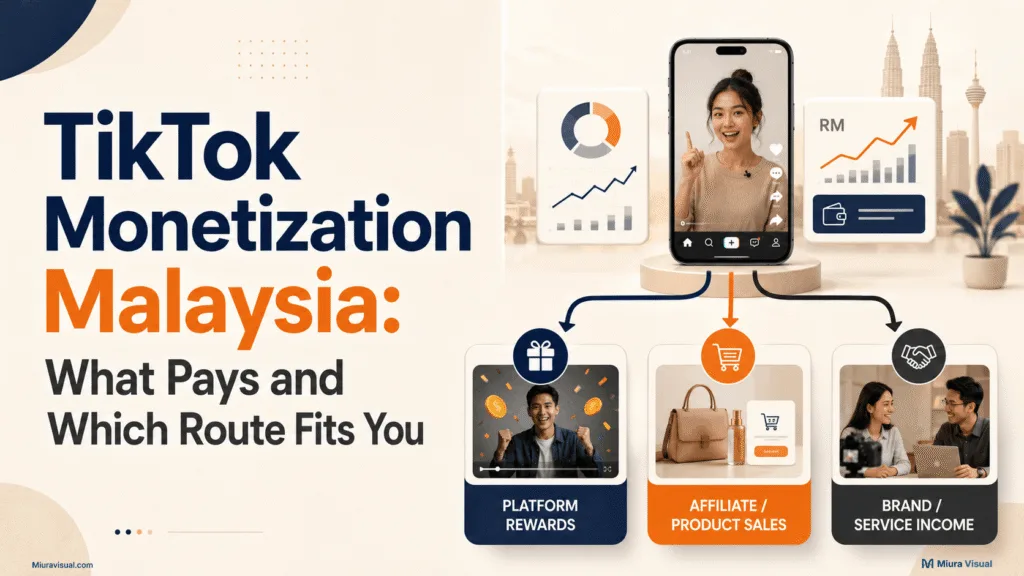
Malaysian creators can use TikTok to earn through platform features, commissions, brand work, client projects and their own offers. This guide shows you how to check your account access, choose a suitable income route, and connect your content to a measurable action.
Quick Answer
Creators can earn money on TikTok in Malaysia.
However, regular video views don’t guarantee a set payment.
TikTok income may come from:
- Eligible platform reward programmes
- LIVE Gifts from viewers
- TikTok Shop Affiliate commissions
- Sponsored content and brand campaigns
- UGC production for businesses
- Sales of your own products
- Enquiries for your services
The right route depends on what you already have.
Product-focused creators may prioritise Affiliate.
Creators with strong video skills but a small audience may be better suited to UGC.
A photographer, consultant, or small business can use TikTok to get enquiries.
They don’t have to wait for platform payouts.
Start by checking TikTok Studio.
Then choose one earning route.
Define the action that brings in revenue.
Track that action instead of just judging success by views.
Does TikTok Pay Creators in Malaysia?
TikTok can support creator income, but “TikTok pays creators” is too broad to be useful.
There are three different ways money may result from TikTok:
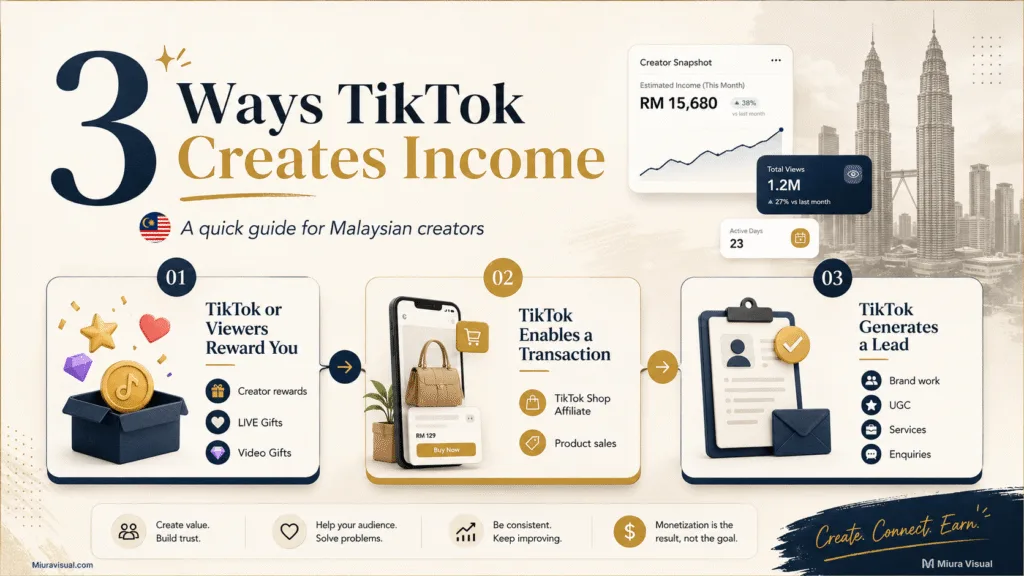
1. TikTok or viewers reward you
This category includes:
- Eligible creator reward programmes
- Video Gifts
- LIVE Gifts
- Other monetization features that depend on your account
Creator Rewards is not a universal payment system for every account.
TikTok requires the account to be registered in an eligible region and to meet the programme requirements.
So, Malaysian creators shouldn’t apply overseas pay-per-view estimates to their accounts.
LIVE and Gift features depend on age.
They also rely on account status, local follower counts, and regional availability.
TikTok states that LIVE and Gifts are not available everywhere.
2. TikTok enables a transaction
TikTok Shop lets eligible creators promote products.
They earn a commission for each qualified purchase.
In this situation, TikTok does not pay simply because someone watches the video.
Revenue relies on a buyer clicking, ordering, and completing the transaction.
The order must also meet the affiliate programme’s validation rules.
Creators new to this payment model should learn about affiliate marketing.
It is important to understand how it works in Malaysia.
A click, estimated order, and confirmed commission are different stages.
3. TikTok generates a lead
A creator may publish content that leads to:
- A photography booking
- A video-production enquiry
- A UGC project
- A sponsored campaign
- A product sale
- A consultation
- A website visit
Platforms like TikTok provide discovery, but the client, brand or customer pays.
This distinction is important.
TikTok is a distribution platform, not just one income stream.
👉 The guide on creator income paths in Malaysia covers the link between platforms and revenue models.
Decision rule: do not ask only, “How much does TikTok pay?” Ask who will pay you and what action must happen before the money is earned.
How Do Malaysian Creators Earn Money on TikTok?
Malaysian creators can earn through several TikTok-related routes.
Each method needs specific assets, eligibility, and content styles.
| Income route | Who pays | Main requirement | Best suited to | Measure first |
|---|---|---|---|---|
| Eligible reward programmes | TikTok | Eligible region, account and content | Creators with qualifying original content | Qualified views and estimated rewards |
| LIVE Gifts | Viewers through TikTok | LIVE and Gift eligibility | Creators with an active live community | LIVE viewers, retention and Gifts |
| TikTok Shop Affiliate | Sellers through commission | Affiliate eligibility and product content | Product-led creators | Product clicks, orders and validated commission |
| TikTok One or direct campaigns | Brands | Eligible account or direct commercial agreement | Creators with a clear niche and audience | Campaign enquiries and paid deliverables |
| UGC production | Brands or clients | Portfolio and production ability | Skilled video creators | Qualified enquiries and projects |
| Own products | Customers | Product, checkout and clear offer | Sellers and small businesses | Purchases and profit |
| Own services | Clients | Portfolio, offer and enquiry path | Photographers, editors and service providers | Enquiries and bookings |
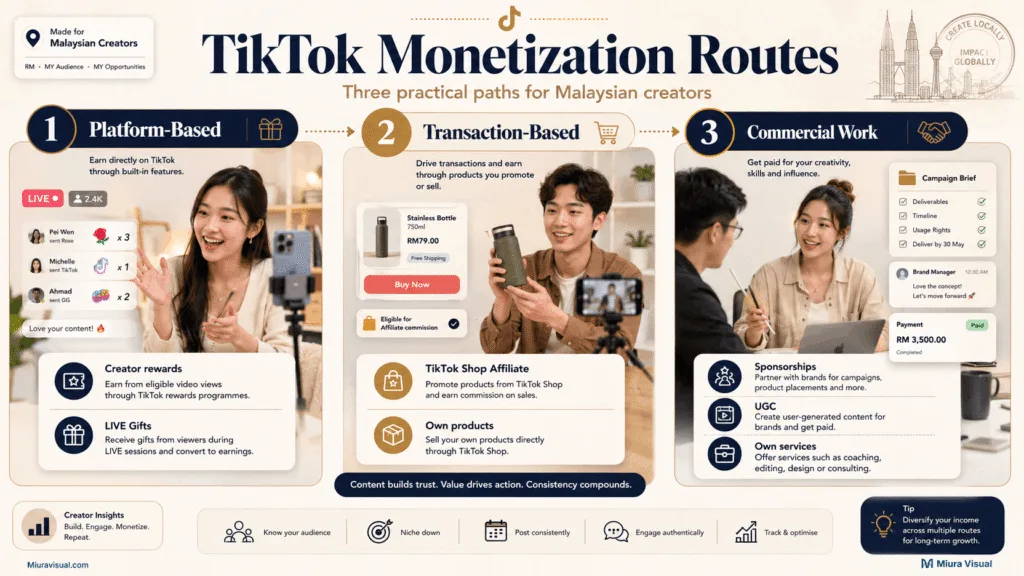
Choose the route closest to an asset you already have.
Do not choose LIVE because it appears popular if you dislike live interaction.
Don’t focus on Affiliate if your content isn’t related to products or buying choices.
TikTok Shop Affiliate
TikTok Shop Affiliate may suit creators who can demonstrate products clearly through short videos, LIVE sessions or product-led content.
TikTok Shop Malaysia separates Link-Share Only and Affiliate Creator functions.
The guidance checks account type, age, and follower count.
It also looks at compliance and identity verification.
The tools offered depend on the creator’s designation.
Affiliate is worth prioritising when viewers regularly ask:
- Where can I buy this?
- Which option should I choose?
- Is this product suitable for my situation?
- How does this product work?
- What should I check before buying?
It’s a low priority when viewers watch for fun and seldom care about products.
LIVE Gifts
Viewers can send you virtual gifts during LIVE streams only when your account meets the relevant age, standing and regional requirements.
TikTok currently requires creators to be at least 18 and meet a local minimum-follower threshold to go LIVE.
Access to Gifts also depends on age, account standing and regional availability.
Feature availability may differ by location and account.
LIVE isn’t worth it if you lack a repeat audience, can’t stick to a schedule, or don’t enjoy long interactions.
Recorded short-form content, UGC or service-led content may be a better use of your production time.
TikTok One, Sponsorships and Brand Deals
TikTok One connects creators, advertisers, and brands for campaign opportunities.
TikTok’s eligibility rules say you need an account in good standing.
You also must meet minimum age and follower counts, plus recent activity.
Some of these rules can change based on your region.
A business can partner with a creator directly after seeing relevant content.
A business can contact a creator directly after seeing relevant content.
A clear personal brand and audience are more commercially useful than random reach.
A creator known for mobile videography, beauty tutorials, home organisation or Malaysian food gives brands a clearer audience fit and a stronger reason to collaborate than an account that changes topics every week.
UGC Content Production
UGC creators handle content creation for brands.
Brands may use these videos across their own organic or paid channels.
This route depends more on production ability than personal audience size.
A useful portfolio may include:
- Product demonstrations
- Talking-head advertisements
- Problem-and-solution videos
- Unboxing content
- Short testimonial-style videos
- Several hooks or edits from the same footage
UGC can produce earlier commercial opportunities than waiting for an audience-based programme.
The trade-off is that it works like client work.
Briefs, revisions, deadlines, usage rights, and approvals are still important.
Your Own Products or Services
A Malaysian small business does not need TikTok to pay directly.
A bakery may create content to promote its products and generate orders.
A photographer may use behind-the-scenes videos to attract bookings.
A web designer can explain common business website problems and direct interested viewers to an enquiry page.
They can also guide visitors to an enquiry page.
This route gives you greater control over the offer.
However, you must provide a clear next step. “Follow for more” may build an audience, but it is not a revenue action.
What Are the TikTok Monetization Requirements in Malaysia?
There is no single TikTok monetization requirement that unlocks every income method.
Each route has separate conditions.
| Route | Common eligibility factor | What to check |
|---|---|---|
| Creator reward programme | Eligible region, age, account status, followers, views and original content | TikTok Studio programme eligibility |
| LIVE Gifts | Age, LIVE access, local follower threshold and account standing | LIVE Center and Gift settings |
| TikTok Shop Affiliate | Creator type, age, account compliance and identity verification | Affiliate Center |
| TikTok One | Account standing, age, followers, recent views and posting activity | Creator Marketplace eligibility |
| UGC | No TikTok monetization feature required | Portfolio and client requirements |
| Own products or services | No TikTok monetization feature required | Offer, sales path and delivery ability |
A creator may be ineligible for one programme but still able to earn through another route.
An editor without access to Gifts can still use TikTok.
They can showcase their editing work and attract client enquiries.
Requirements Depend on the Earning Route
Do not chase one follower target without knowing what it unlocks.
TikTok’s general eligibility criteria for TikTok One currently include:
- Being at least 18 years old
- Having an account in good standing
- Having at least 10,000 followers
- Receiving at least 1,000 post views within the last 30 days
- Publishing at least three posts within the last 30 days
Some age and follower requirements may vary by region, so check the in-app eligibility shown for your account.
Full TikTok Shop Affiliate Creator access generally requires at least 1,000 followers, age 18 or above, an account in good standing, and completed identity verification.
Creators below the follower threshold may still qualify for the Affiliate Link Program.
However, Linkshare accounts receive more limited functions until they meet the requirements for full Affiliate Creator access.
LIVE uses a local follower threshold.
This means different countries have different numbers, not one universal figure.
Use official account eligibility as the source of truth.
Blog posts, screenshots, and videos can get outdated.
This happens when TikTok changes program access or account types.
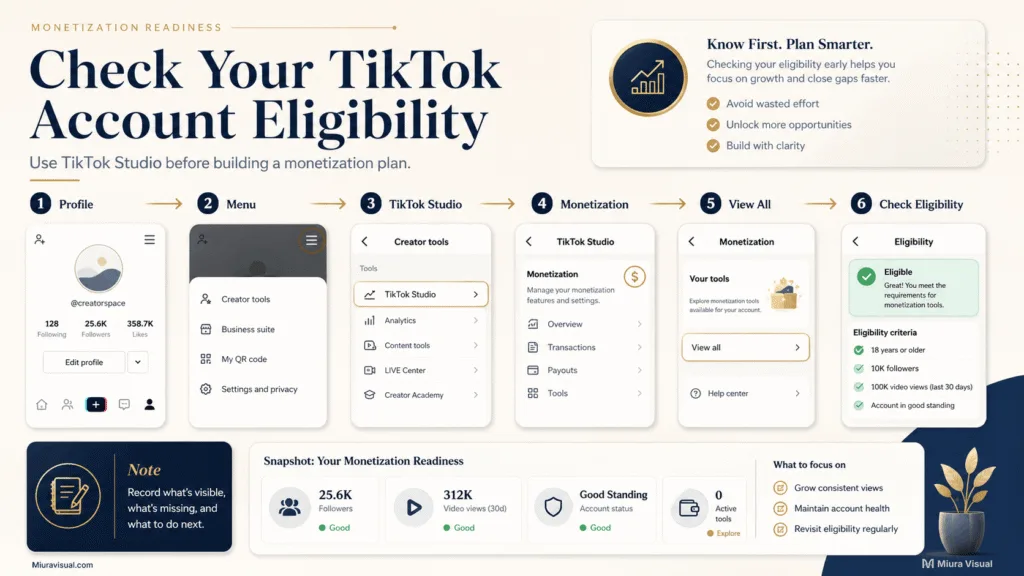
How to Check Your TikTok Account Eligibility
Use this workflow before building a content plan around a feature:
- Open your TikTok profile.
- Tap the Menu button.
- Open TikTok Studio.
- Select the Monetization tab.
- Tap View all if the full list is not visible.
- Review active programmes and programmes available to join.
- Open each relevant programme and check its missing requirements.
- Record the next action instead of relying on memory.
TikTok Studio shows active programmes, estimated rewards, balances and other monetization options available to your account.
For TikTok One, the official path continues through Creator Marketplace → Check eligibility.
Create a simple record:
| Programme | Visible? | Eligible? | Missing requirement | Next action |
|---|---|---|---|---|
| TikTok Shop Affiliate | Yes | No | Follower requirement | Continue product-led content |
| TikTok One | Yes | No | Recent views | Improve niche consistency |
| LIVE Gifts | No | Unknown | Feature unavailable | Recheck later |
| Own service | Not required | Ready | Enquiry page | Add clear profile link |
This check prevents you from building a strategy around a feature that your account cannot currently access.
Which TikTok Monetization Route Fits What You Already Have?
Choose based on your strongest current asset, not on impressive income screenshots.
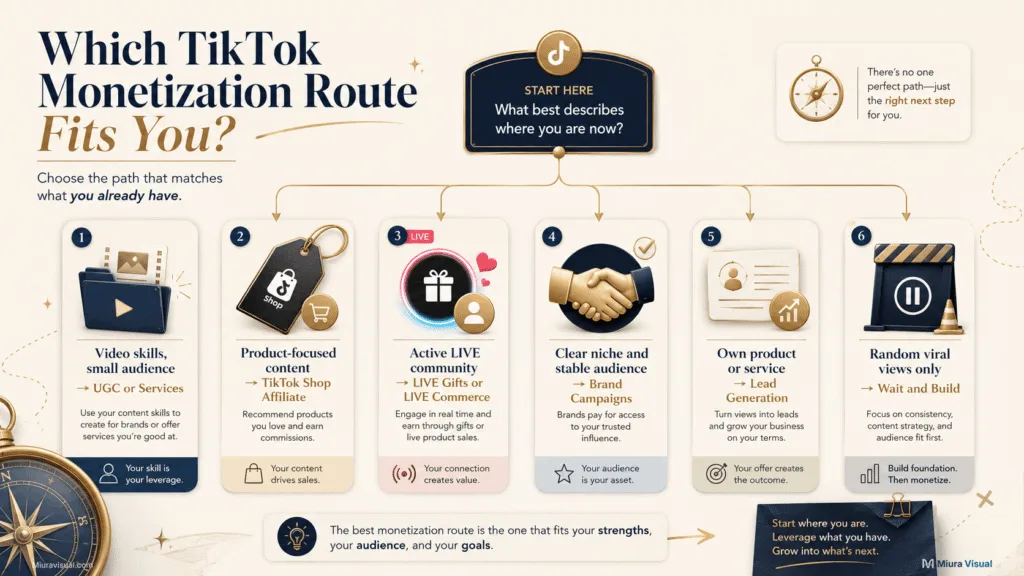
You have video skills but no meaningful audience
Prioritise UGC or services
Build a small portfolio that proves you can:
- Explain a product and its benefits clearly
- Follow a commercial brief
- Edit clean and usable footage
- Produce several hooks or variations from the same concept
You can pitch these skills without waiting for a large following.
A marketable production skill may create income earlier than an audience-dependent platform payout.
You regularly create product content
Prioritise TikTok Shop Affiliate.
Product-led content works best when the viewer has a real decision to make.
Demonstrations, comparisons, setup tips, and handling objections work better.
They are more effective than just linking products to trending videos.
Start with one product category.
Mixing beauty tools, camera accessories, kitchen gadgets and unrelated software makes it difficult to identify which product category attracts qualified interest.
You have an active community and enjoy LIVE content
Consider LIVE Gifts or LIVE commerce.
This route requires more than LIVE access. You need a reason for viewers to stay, interact, and return.
A creator who can answer questions, demonstrate products, teach a process or host regular sessions has a stronger LIVE proposition.
This is stronger than someone who just starts broadcasting with no clear format.
You have a clear niche and stable audience
Consider brand campaigns.
Brands need to understand who your audience is and what you can create.
Prepare a professional profile, clear contact method, relevant content examples, and realistic deliverables.
Do not accept an unrelated campaign simply because it is paid.
Short-term income can weaken the audience trust required for better collaborations later.
You own a product or provide a service
Use TikTok as lead generation.
This route can work before you qualify for platform programmes.
A photographer can show the preparation, shooting process, and final result.
A small business can answer common customer questions.
A content marketer can identify common mistakes and direct interested viewers to a service page.
The commercial action should be clear:
- Book a session
- Request a quotation
- Visit the product page
- Send an enquiry
- Join a waitlist
- Download a resource
You only have random viral views
Wait before monetizing aggressively.
Viral content does not show what people trust you for or what they may buy.
First identify a repeatable topic, audience problem, and content format.
Adding unrelated affiliate products or offers now might generate activity.
However, it won’t provide useful commercial evidence.
Can You Make Money on TikTok Without Many Followers?
Yes, but the available routes change.
A small following can limit some account features.
It may also reduce your chances for audience-based sponsorships.
You can still sell your skills, generate enquiries, and promote your own offer.
Low-follower routes
Consider:
- UGC production
- Video editing
- Photography or videography enquiries
- Content-production support
- Your own products
- Your own services
- Eligible Affiliate Link Program or Affiliate functions shown in your account
A beginner videographer could create three sample product videos for a simple portfolio.
Those videos can demonstrate production ability even if the account has limited reach.
A photographer can share a quick behind-the-scenes look.
This could show the problem, the setup, and the final image.
The useful metric would be profile visits and qualified enquiries, not only likes.
A Malaysian small business can answer a common customer concern and direct interested viewers to a product page or booking option.
A small group of engaged viewers can be more valuable than a big entertainment crowd.
However, few followers does not mean zero requirements.
You still need proof, a clear offer, dependable delivery, and any platform eligibility for the chosen feature.
How to Turn TikTok Views Into a Measurable Revenue Path
A view is attention. Monetization requires another action.
Build one complete path instead of adding several unrelated calls to action.
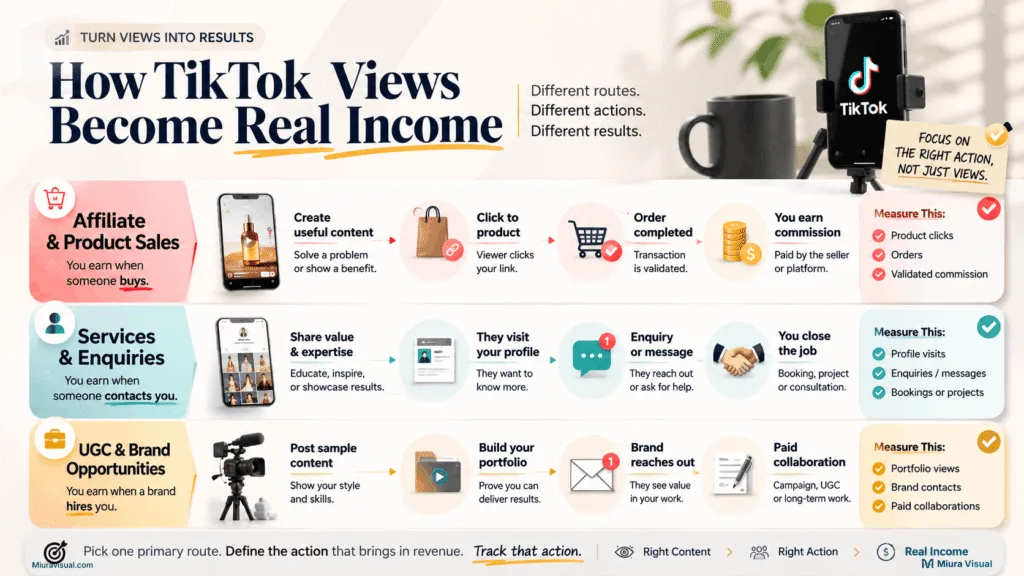
Affiliate path
Product problem → Useful demonstration → Product click → Valid order → Confirmed commission
A creator shares why handheld phone footage can look shaky.
They show a good tripod and guide viewers to the product.
Track:
- Product-link clicks
- Orders
- Validated commission
Do not judge the video only by views.
Many views but few clicks might show that people are curious but not ready to buy.
Service path
Problem or result content → Profile visit → Portfolio or enquiry → Qualified conversation → Booking
Example: A photographer demonstrates how bad lighting impacts a product image. Then, they show the correct setup and the final result.
Track:
- Profile visits
- Website visits
- Enquiries
- Quoted projects
- Confirmed bookings
A video with 3,000 views and two qualified enquiries may be more commercially useful than one with 50,000 views and no action.
UGC or brand path
Commercial content sample → Portfolio → Brand contact → Agreed scope → Paid deliverable
Example: A creator makes three versions of a product video. Each version uses a different opening hook.
The content shows what the creator can offer a brand.
It focuses on skills, not just follower count.
Track:
- Portfolio visits
- Outreach replies
- Brand enquiries
- Approved projects
Use a simple tracking sheet
| Date | Content | Route | CTA | Views | Profile visits | Clicks | Enquiries | Orders | Revenue |
|---|---|---|---|---|---|---|---|---|---|
Review the sheet after several focused posts.
- Views but no action: the content or CTA may not connect to the offer.
- Profile visits but no enquiry: the profile, proof, or offer may be unclear.
- Clicks but no order: the product, price, reviews, or buyer fit may be weak.
- Enquiries but no booking: scope, pricing, trust, or response time may be the problem.
Fix the stage where the path breaks. Publishing more videos will not solve an unclear offer or poor product fit.
Common TikTok Monetization Mistakes Creators Make
Most TikTok monetization issues come from three main problems.
First, content may connect to the wrong income action.
Second, creators often use outdated information.
Lastly, many try too many methods before finding what works.
| Avoid this | Do this instead |
|---|---|
| Assume high views will automatically generate income. | Define what happens after the view. Then track clicks, orders, enquiries, Gifts or campaign opportunities. |
| Use overseas Creator Fund figures to estimate Malaysian earnings. | Check TikTok Studio and current programme eligibility before making any income estimate. |
| Test Affiliate, LIVE, UGC, sponsorships and product sales at the same time. | Choose one primary route first and add another only after the first produces clear data. |
| Publish useful content without a commercial next step. | Give each monetization-focused post one clear CTA, such as visiting a product, portfolio or enquiry page. |
| Promote products only because they offer a high commission. | Select products that address the problems your audience has raised. Make sure they relate to your content topic. |
| Count free products as cash income. | Record cash payments, commission, gifted-product value and expenses separately. |
| Publish affiliate or sponsored content without checking disclosure rules. | Review the relevant programme and branded-content requirements before publishing. |
| Depend entirely on one TikTok feature or algorithm. | Build an extra asset such as a portfolio, website, customer list, searchable channel or repeat-client relationship. |
Choose one realistic revenue path, connect it to a measurable action, and identify where the process breaks.
Producing more content will not fix an unclear offer, weak product fit or missing CTA.
Should You Start TikTok Monetization Now, Wait or Choose Another Route?
Start now when you have:
- A clear content topic
- One suitable income route
- A visible or accessible programme, product, service, or offer
- A repeatable content format
- One commercial action to track
- Enough time to review the result properly
For example, a product creator with Affiliate access can test one product category.
A videographer without a big audience can share UGC samples.
They can then begin targeted outreach to relevant brands, agencies or businesses.
Wait and build when you have:
- An empty or private account
- No repeatable topic
- Constantly changing content
- No product, service, portfolio, or audience problem
- No way to handle enquiries or delivery
- No available programme that fits your current account
Waiting should have a purpose.
Use the waiting period to build proof, publish focused content, improve your profile and develop a clear offer before monetizing.
Choose another route when you:
- Need predictable cash quickly
- Already have a marketable skill
- Dislike frequent short-form production
- Do not want to host LIVE sessions
- Have no interest in product-led content
- Prefer search-based or long-form content
- Cannot tolerate platform-dependent income
A skilled photographer or editor needing quick income should focus on a specific service.
Waiting for platform rewards is not the best choice.
Conclusion: Choose One TikTok Revenue Action
The key decision is whether your account, content and current assets can support a specific revenue action.
Start when you know who will pay, what content supports the offer, and which result you will measure.
Wait when you only have scattered views and no clear route.
Prioritise a skill-based or broader creator income option when TikTok’s available features do not match your immediate needs.
Open TikTok Studio, record the programmes available to your account, and choose one path.
Publish content with one clear CTA and track the commercial result before adding another monetization method.
Frequently Asked Questions
Can TikTok be monetized in Malaysia?
Yes. Malaysian creators can earn money through various TikTok features. These include LIVE Gifts, the TikTok Shop Affiliate, brand campaigns, UGC, and selling products and services. Availability and requirements differ by route and account.
How much does TikTok pay for 1,000 views in Malaysia?
There is no fixed rate that applies to every Malaysian TikTok account. Platform reward programmes need eligible accounts and regions. Income from affiliates, brands, products, and services depends on commercial actions, not just views.
Is TikTok Creator Fund available in Malaysia?
The old Creator Fund should not be used to estimate current Malaysian earnings. TikTok has replaced the Creator Fund with Creator Rewards in participating markets. To join, you need an account from an eligible region.
Do I need 10,000 followers to make money on TikTok?
No. Some platform programmes need follower counts. However, UGC, client services, and selling your own products don’t need 10,000 followers. Each TikTok programme has separate eligibility conditions.
Do I need a verified account to earn money?
A verified badge is not a universal requirement for TikTok monetization. What matters is meeting the specific requirements for the route you choose. This includes eligibility, account standing, identity, content, and activity.

Miura Visual
Transforming visuals into content, stories, and scalable value across platforms and audiences.
Related Article