Brand Collaborations in Malaysia: How Creators Find Deals and Make Money
Brand collaborations in Malaysia can help creators earn money. But this works only if the commercial structure is clear. This guide helps you find good opportunities. You’ll learn to pick a payment model. Then, you’ll define roles for everyone involved. Next, you’ll price your contribution and decide if the deal is worth it.

Quick Answer
Creators can make money from brand collaborations through several models:
- A fixed fee for sponsored content
- A project fee for content production
- A fixed fee plus affiliate commission
- Referral fees for qualified leads
- Joint service projects with complementary partners
- Revenue sharing for selected events, products, or campaigns
The best model depends on what you already contribute.
A creator with an engaged audience may sell access to that audience.
A photographer may sell production skills.
A studio may provide space.
A specialist may handle editing or post-production.
Do not decide the payment split first. Start by asking:
Who contributes what, who carries the cost, and what action creates the revenue?
👉 If you’re unsure about brand deals, check out the creator income paths in Malaysia first.
How Do Brand Collaborations Actually Make Money for Creators?
A collaboration becomes monetization when there is a clear link.
This means contributions must lead to payment.
“Working with a brand” is too vague.
Two collaborations might seem alike across social media platforms.
However, they use different income models.
| Collaboration model | What the creator contributes | How income is created |
|---|---|---|
| Sponsored content | Content + audience access | Brand pays a fixed fee |
| Content production | Photography, video, editing, or other skills | Client or brand pays a project fee |
| Hybrid deal | Content + measurable promotion | Fixed fee + commission |
| Referral partnership | A relevant lead or customer introduction | Referral fee |
| Joint service | One part of a larger client solution | Each partner earns from an agreed project structure |
| Joint event or offer | Skill, audience, venue, content, or resources | Agreed revenue share or separate fees |
The key question is what the brand is actually buying.
A sponsored Instagram Reel may involve payment for content creation and audience access.
A product video made for the brand’s own account is closer to production work.
A tracked product recommendation may depend partly on affiliate commission.
These models should not use the same pricing logic by default.

Separate attention from production
Creators often bundle everything into one vague “collab rate.”
That can hide several different contributions:
- Planning
- Shooting
- Editing
- Posting
- Audience access
- Product demonstration
- Usage rights
- Additional versions
- Travel
- Studio costs
Before quoting anything, identify which parts the project actually needs.
That makes the price easier to explain and reduces scope problems later.
Which Brand Collaboration Model Fits What You Already Have?
Don’t pick a collaboration model just because another creator is doing well with it.
Start with the asset you already have.
You already have a relevant audience
Prioritise collaborations where the brand benefits from your audience relationship.
Suitable models may include:
- Sponsored posts
- Sponsored videos
- Brand campaigns
- Fixed fee + performance commission
Audience size can help, but audience relevance matters too.
A creator who talks about photography gear helps a camera brand more.
They give a clearer reason to collaborate than a general account without a link to the product.
You have strong production skills but a small audience
Do not wait for a large follower count before monetising the skill.
You can sell photography, videography, and editing.
You can also sell product demos and other production work.
You don’t need to rely on your personal connections.
The brand is paying for the content asset, not only your audience.
This is great for photographers, videographers, editors, and creators. They can make strong commercial content.
You have product-focused content
A hybrid structure may make more sense.
For example:
Content fee + validated affiliate commission
The fixed fee pays for the production work.
The commission rewards measurable sales performance.
👉 If commissions are important, keep tracking and validation in your affiliate marketing strategy. Don’t count every click as income from collaboration.
You Have a Network for Referral Partnerships
A referral partnership may fit better than sponsored content.
For example, a creator may receive an enquiry that needs a service they do not provide.
They might not reject the opportunity.
Instead, they can refer the client to a suitable partner as part of an agreed arrangement.
A creator doesn’t have to appear in an ad for the collaboration to be valuable.
You Need a Partner for a Missing Skill or Resource
Look for a complementary service partner.
A photographer may need:
- A studio
- A makeup artist
- Advanced retouching
- Video support
- Styling
- Event space
Focus on the part you should own, then use a suitable partner to fill the capability or resource gap.
Decision rule: First, monetize the asset you have. Then, consider copying the most visible collaboration model.
How to Get Brand Collaborations in Malaysia
Brand collaborations in Malaysia are easier when a brand knows what you offer right away.
You do not need to look like a large influencer agency.
You do need enough proof for someone to make a commercial decision.
1. Make your creator position clear
A brand should understand what you are known for.
A focused creator profile may be built around:
- Photography
- Mobile videography
- Beauty
- Food
- Technology
- Cosplay
- Fitness
- Business education
- Product reviews
- A specific lifestyle niche
Random reach is harder to sell than relevant reach.
2. Show proof that matches the collaboration you want
Use proof that supports the actual offer.
For sponsored content, that may include relevant content and audience information.
For production work, the portfolio matters more.
For a photographer, useful proof may include:
- Finished photography
- Behind-the-scenes work
- Product shoots
- Campaign visuals
- Editing examples
For a video creator, show the type of video a brand could realistically commission.
3. Make the commercial path obvious
Do not make a brand guess how to contact you.
Your profile, website, or portfolio should provide a clear enquiry path.
A media kit can help when brands need audience and campaign information.
It is useful, but it is not a substitute for a clear offer.
4. Approach brands that already fit your content
Do not begin with the longest possible list of companies.
Start with brands that fit your target audience or skills.
Your proposal should show what you can create, why it is relevant, and what business outcome it may support.
A useful proposal gives the brand something clear to assess.
For example, you may already create content about compact creator equipment.
You can suggest a quick demo that shows how the product works in a small filming setup.
5. Check Instagram and TikTok Collaboration Tools
👉 Check the current workflow for Instagram branded content. Visit Instagram monetization in Malaysia for details.
👉 For TikTok-specific brand opportunities and platform eligibility, use the TikTok monetization guide.
This article focuses on commercial collaboration. It does not repeat the rules of each platform.
What Should You Confirm Before Accepting a Brand Collaboration?
Do not accept a deal from the headline alone.
“RM500 collaboration” tells you almost nothing if the scope is unclear.
Before agreeing, confirm these ten items.
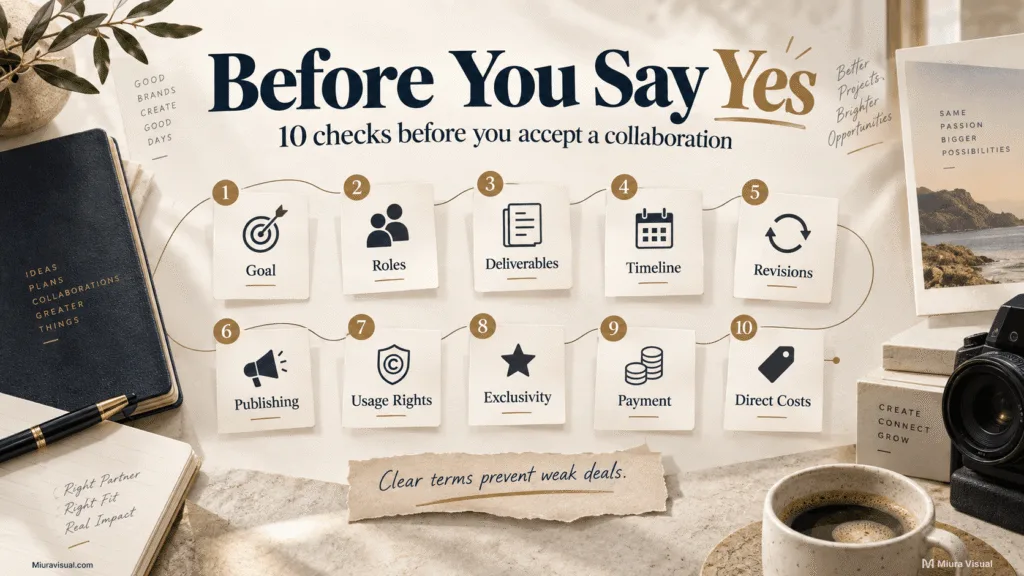
1. Goal
What does the brand want?
Examples include:
- Brand awareness
- Product launch
- Sales
- Leads
- Content assets
- Event coverage
- Product demonstration
The goal affects what should be delivered.
2. Roles
Write down who handles each part.
For example:
- Who communicates with the client?
- Who provides the product?
- Who handles photography?
- Who edits?
- Who books the location?
- Who publishes?
- Who handles revisions?
Miura Visual follows the same idea for partner work: each side must have a clear role before starting.
3. Deliverables
Do not agree to “some content.”
Confirm the actual output.
For example:
- 1 Reel
- 5 edited photos
- 3 Stories
- 1 product demonstration
- 2 revised versions
- 1 landing-page visual set
4. Timeline
Confirm:
- Production date
- Draft date
- Review period
- Posting date
- Final delivery date
A rushed deadline may change the price or make the project unsuitable.
5. Revisions
Define how many revision rounds are included.
A fixed price with unlimited revisions is not a clear scope.
6. Publishing responsibility
Who publishes the content?
A creator posting on their own account adds value.
This is different from someone making content for the brand to share.
7. Usage rights
Ask where the final content can be used.
Organic social posting is different from:
- Paid advertising
- Website use
- Marketplace listings
- Third-party licensing
- Long-term campaign use
Do not treat every use as automatically included.
8. Exclusivity
Check whether the agreement prevents you from working with competing brands.
An exclusivity condition has commercial value because it removes other opportunities.
9. Payment
Confirm:
- Amount
- Deposit if applicable
- Balance
- Payment method
- Payment timing
- Commission conditions if relevant
10. Direct costs
Do not forget the expenses needed to produce the work.
Possible costs include:
- Studio rental
- Transport
- Props
- Assistants
- Makeup or styling
- Equipment rental
- Special editing
- Rush delivery
Mistake to avoid: Don’t accept a collaboration just because the headline fee seems good. You might find that production costs take up most of that fee.
How Should Malaysian Creators Price or Split a Brand Collaboration?
There is no useful rule that says every collaboration should be split 50/50.
Two people can be involved, but that doesn’t mean they share costs.
They might not do equal work, take on the same responsibility, or face the same risk.
A better structure starts with seven questions:
- Who brought the opportunity?
- Who performs the work?
- Who pays direct costs?
- Who communicates with the client?
- Who provides the audience or customer access?
- Who handles revisions and problems?
- Who owns or can use the final asset?
Then choose a payment structure.

Model 1: Separate service fees
This is useful when each partner has a clearly separate job.
For example:
Studio → studio fee
Photographer → production fee
Retoucher → retouching fee
Each contribution is easier to price.
There is no need to force everything into a percentage.
Model 2: Referral Partnership Fee
This fits when one partner mainly introduces the customer.
For example:
Client pays the service provider
Referring partner receives the agreed referral fee
The referral fee should be agreed before leads are exchanged.
Model 3: Fixed fee + commission
This works when the creator provides content and also helps generate measurable sales.
For example:
Creator production fee + Validated affiliate commission
Keep the two parts separate.
The production fee pays for work already completed.
The commission depends on buyer behaviour and programme validation.
Model 4: Revenue share
Revenue sharing works best when both sides truly help create a shared offer.
A simple model is:
Gross revenue − agreed shared direct costs = net collaboration revenue → agreed split
This may fit a joint workshop, event, package, or selected product project.
However, revenue sharing needs more tracking.
Both sides should agree on:
- What counts as revenue
- Which costs are deducted
- Who receives customer payments
- When settlement happens
- How refunds are handled
Miura Visual’s practical rule: split money based on contribution, cost, responsibility, and risk. Do not split it only by headcount.
What Do Real Complementary Partnerships Look Like?
Not every creator collaboration needs a large marketing campaign.
Sometimes the commercial value comes from combining two useful capabilities.

D.Creator Project + Miura Visual Photo Retouching
D.Creator Project handles the photography side of its cosplay work.
If images need extra finishing, Miura Visual helps.
Miura Visual can provide advanced photo retouching and creative post-production.
The value comes from role separation:
Photography → advanced post-production → more complete final image
The photographer doesn’t have to handle every advanced editing task themselves.
This is an internal example of the Miura creator workflow.
It’s not a separate external brand sponsorship.
The same lesson applies to independent creators.
A collaboration lets you sell more.
You don’t need to have every skill on your own.
JVibe Studio + Miura Visual
The JVibe Studio model works differently.
JVibe Studio provides the studio environment.
Miura Visual provides photography, videography, or related production support.
That creates a simple complementary structure:
Studio access + creative production → complete shoot solution
The studio does not need to become a photography company. Miura Visual does not need to own a permanent studio.
Each side contributes something different.
This type of brand partnership is also close to the partner collaboration opportunities Miura Visual develops with complementary businesses.
What creators should learn from these models
Creators should look beyond sponsorships.
Teaming up with a partner can lead to a stronger commercial offer.
Your skill and their resources make something you both couldn’t achieve alone.
For a smaller creator, this question can lead to real chances.
It’s better than waiting for a big sponsorship.
When Is a Brand Collaboration Not Worth Accepting?
A brand deal does not become good simply because a brand says yes.
Use three possible decisions:
Accept when the role, value, scope, rights, and payment make sense.
Renegotiate when the opportunity is useful but one or more terms are weak.
Decline when the deal creates more cost, restriction, or risk than realistic value.
Common warning signs include:
- The brand does not fit your audience or creator position
- The payment is product-only while production costs are high
- Deliverables are unclear
- Revisions are unlimited
- Usage rights are vague
- Paid advertising use is expected without being discussed
- Exclusivity is broad but compensation is weak
- The partner cannot explain their own responsibility
- The project depends on “exposure” with no useful strategic value
Free products are not the same as cash
A gifted product may still have value.
However, do not record a RM500 retail product as if RM500 entered your bank account.
Separate:
- Cash
- Commission
- Product or barter value
- Direct costs
- Actual profit
This helps you see if collaborations benefit your creator business.
Not every valuable collaboration needs immediate cash
A carefully chosen collaboration may create:
- Portfolio proof
- Access to a useful location
- A new service capability
- A relevant introduction
- Content
- Audience exposure
- A future referral relationship
But the value should be specific.
“Maybe this gives me exposure” is not enough.
How Do You Turn One Collaboration Into Repeatable Income?
Do not judge a collaboration only on the day it launches.
Save enough information to make the next decision better.
After the project, record:
- Cash received
- Commission earned
- Product or barter value
- Direct expenses
- Production time
- Final deliverables
- Usage agreed
- Performance data if available
- Partner or client feedback
- Problems that appeared
- Whether the collaboration should be repeated
Review whether the same structure is worth using again.
If yes, turn the useful parts into a repeatable offer.
For example:
- A one-off studio collaboration may become a repeat studio-production package.
- A successful referral may become a clearer preferred-partner arrangement.
- A sponsored product video may become a repeat campaign format.
- A hybrid campaign might show that fixed-fee production is useful.
However, the commission part might not be worth it.
The goal is not to collect as many collaborations as possible.
The goal is to find out which collaboration structure makes money.
It should also provide proof or business opportunities.
It should not use more resources than it gives back.
Conclusion
Brand collaborations in Malaysia are worth it.
You just need to show what you bring, how money is made, and who does what.
Start now if you have a helpful audience, production skills, a portfolio, a network, or a partner.
Renegotiate when it’s relevant.
Do this if the scope, payment, rights, or responsibilities aren’t clear.
Wait or decline when you cannot identify the real value of the deal.
Your next step is to jot down one asset you can offer.
Then, pick a collaboration model that can turn that asset into a clear commercial outcome.
Frequently Asked Questions
Do I need a large following to get brand collaborations in Malaysia?
No. A large audience helps with sponsorships where the brand is paying for reach.
Production work relies on skill, portfolio, and resources. Referrals and partnerships do too. Follower count is less important.
Can I make money from collaborations without posting sponsored content?
Yes. Creators can earn through production fees, referral fees, service partnerships, joint projects, or selected revenue-sharing arrangements.
Sponsored social content is only one collaboration model.
Is a gifted collaboration considered paid work?
A gifted collaboration provides non-cash value.
Track the product separately from cash income. Also compare its real value with the time and production costs required.
Do I need a media kit before approaching brands?
Not always. A media kit helps when you need to quickly check audience info, campaign formats, and past work. A strong portfolio and a clear offer can be more important for collaborations in production or services.
What is the difference between a brand collaboration and affiliate marketing?
Brand collaboration is a broader commercial relationship. Payment may involve fixed fees, production work, referrals, revenue sharing, or a combination.
Affiliate marketing is performance-based. The creator earns commission after a qualifying tracked action or purchase.

Miura Visual
Transforming visuals into content, stories, and scalable value across platforms and audiences.