How to Make Money With a Blog in Malaysia?
A blog can make money in several ways, but the right method depends on what your website already has. This guide will help you choose what to monetise first, check if your blog is ready, and run a simple test without adding every income stream at once.

Quick Answer
You can make money with a blog through:
- Display advertising
- Affiliate marketing
- Services and enquiries
- Digital or physical products
- Sponsored content
But do not start with all five.
A small blog with little traffic should usually focus on useful blog content and search visibility first.
A page attracting product-related searches may be ready for affiliate links much earlier.
A blog can show that professional expertise drives service inquiries. You don’t need thousands of visitors to make it work.
Traffic alone does not tell you how to monetize a blog.
Look at why people visit the page and which commercial action fits that intent.
👉 If you are still deciding whether blogging is the right income route, start with our guide to creator income paths in Malaysia.
How Do Bloggers Make Money?
A blog does not create income just because someone reads an article.
There needs to be a path from the content to a commercial action:
Content → Visitor → Intent → Commercial action → Revenue
Different blog monetization methods work because they monetise different things.
| Monetization method | What it mainly monetises | Example action |
|---|---|---|
| Display ads | Attention and traffic | Visitor views an ad |
| Affiliate marketing | Purchase intent | Reader buys through a tracked link |
| Services | Expertise and trust | Reader sends an enquiry |
| Products | A problem or desired outcome | Reader buys a product |
| Sponsored content | Audience and authority | Brand pays for exposure or content |
This distinction matters.
An informational article with thousands of readers may work well with display ads.
It may perform poorly with affiliate links if readers are not considering a purchase.
A comparison article may get less traffic but have stronger commercial intent.
Affiliate recommendations help guide readers who are already comparing products.
A photographer’s guide may work differently.
The reader may not buy anything from the article.
However, the content can show enough expertise to generate a photography enquiry.
Decision rule: monetise the reason people visit the page.
Do not force every page into the same revenue model.
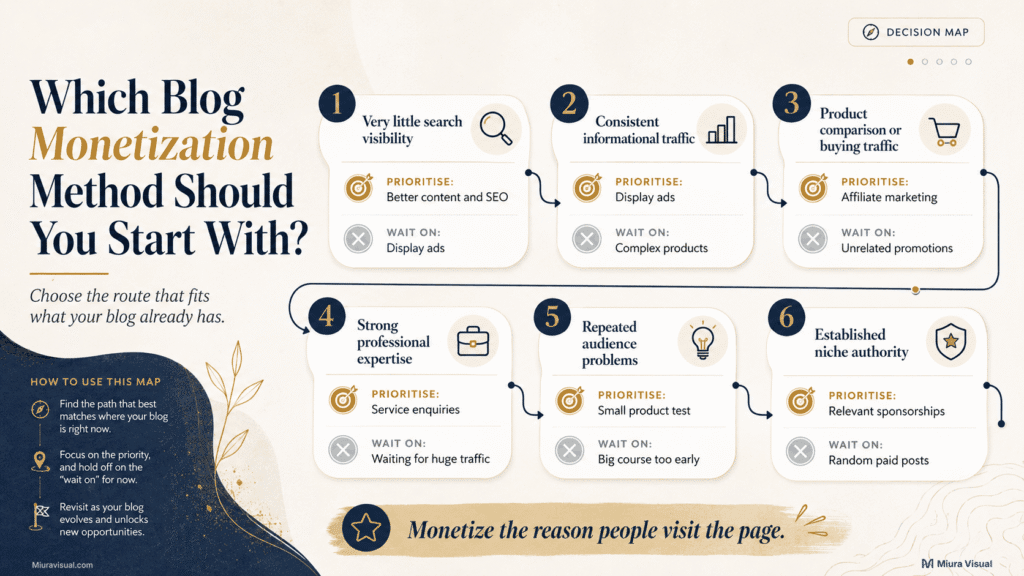
Which Blog Monetization Method Should You Start With?
Start with the asset your blog already has.
Do not choose a method because another blogger makes good money from it.
| What your blog has now | Prioritise | Lower priority for now |
|---|---|---|
| Very little search visibility | Better content and SEO | Display ads |
| Consistent informational traffic | Display ads | Complex products |
| Product comparison or buying traffic | Affiliate marketing | Unrelated ads or promotions |
| Strong professional expertise | Service enquiries | Waiting for huge traffic |
| Repeated audience problems | Small product test | Building a large course immediately |
| Established niche authority | Relevant sponsorships | Random paid posts |
The important word is relevant.
For example, a photography website may attract readers searching for camera settings, lighting problems and equipment comparisons.
A camera comparison can naturally support affiliate recommendations.
A portfolio breakdown may suit a photography service enquiry better.
A basic photography definition may simply build traffic and support display advertising later.
There is no reason to force one monetization method across all three pages.
Avoid choosing by earning potential alone
Affiliate commissions may look more attractive than advertising revenue.
Digital products may seem more scalable than services.
Neither matters if your website does not have the conditions needed to make the model work.
A high-value offer with no suitable reader is still a weak monetization path.
Choose the shortest realistic path between the reader’s current problem and a useful paid action.
How to Check If You’re Ready to Monetize Your Blog
You do not need a complicated monetization calculator.
Start with Google Search Console and Google Analytics.
The goal is to find out whether your current problem is:
- Visibility
- Traffic
- Search intent
- Monetization
- Conversion
Treat those as different problems.
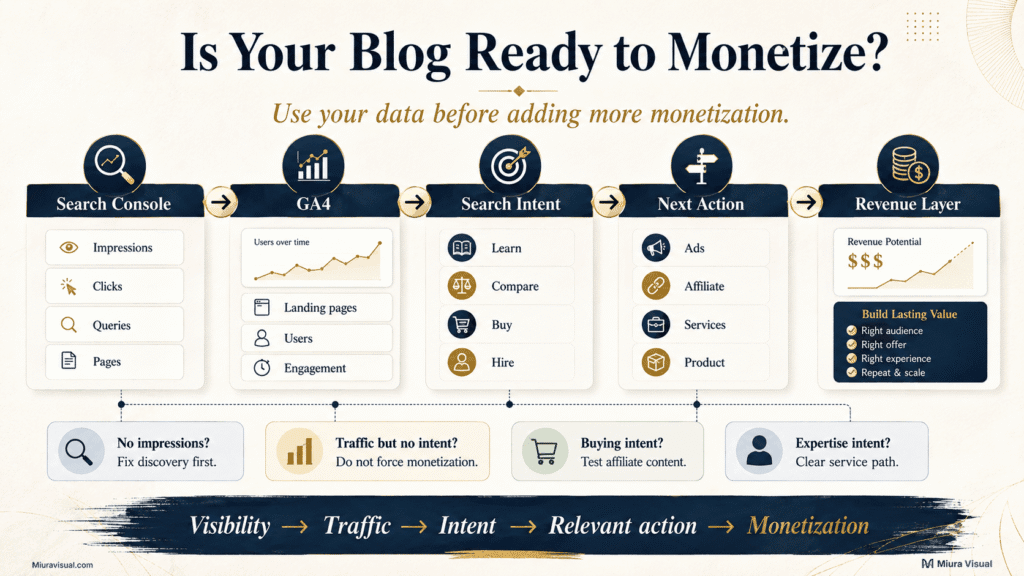
Step 1: Check whether Google is finding your content
Open Google Search Console and review:
- Impressions
- Clicks
- Queries
- Pages
If most important pages receive almost no impressions, monetization is unlikely to be the priority.
Your first problem is discovery.
You may need better topic selection, stronger content, clearer search intent or better internal linking before revenue optimisation becomes useful.
Step 2: Find the pages that already attract visitors
Next, identify which articles receive meaningful impressions and clicks.
Then check GA4 to see which landing pages actually receive users.
Do not evaluate the whole website as one number.
A small site may have ten weak articles and one page that already attracts useful search engine traffic.
That page deserves closer attention.
Step 3: Read the queries behind each page
Traffic alone does not tell you how to monetise the page.
Look at what people searched before arriving.
For example:
- “what is aperture” suggests learning intent.
- “Best microphone for talking videos” suggests product research.
- “photo retouching service malaysia” suggests service intent.
- “camera A vs camera B” suggests a decision is being made.
The second and fourth queries have a clearer path toward affiliate content.
The third may support a service enquiry.
Step 4: Define one useful next action
Give the reader one relevant next step after the article.
That could be another guide, a product comparison, an affiliate link, or a service page.
Possible actions include:
- Read another guide
- Compare a recommended product
- Click an affiliate link
- Visit a service page
- Join an email list
- Buy a resource
Do not add a commercial call to action simply because a page gets traffic.
The action should fit the problem that brought the reader there.
Step 5: Choose the monetization layer
Only now should you choose between ads, affiliate links, services or products.
This is the blog monetization readiness check we would use for a small content website:
Visibility → Traffic → Intent → Relevant action → Monetization
Skipping the first four stages can leave a website full of monetization features but very little revenue.
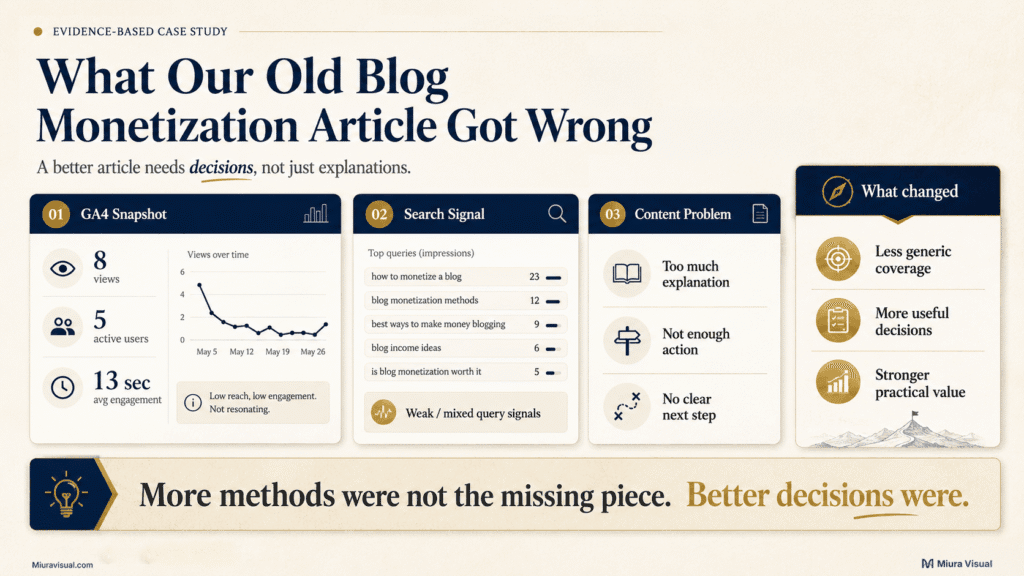
What Our Old Blog Monetization Article Got Wrong
Miura Visual had already published an earlier version of this guide.
The article discussed AdSense, affiliate marketing, authority and long-term blogging income. Much of the information was reasonable.
The problem was that the article did not give readers enough to do.
It explained monetization as a concept.
It did not help readers inspect their website, choose a method for their current traffic, or work out why revenue was not appearing.
Our own numbers made that weakness difficult to ignore.
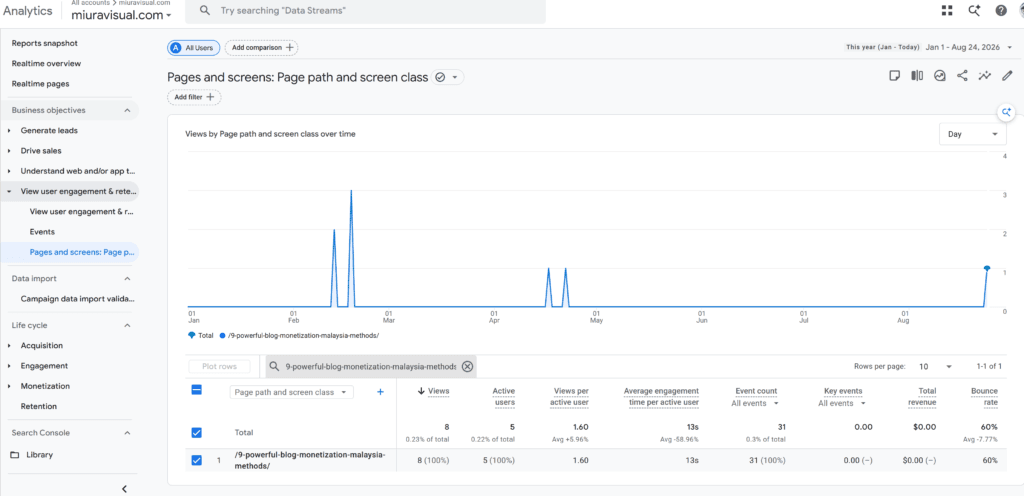
In the GA4 view we reviewed from January 1 to August 24, 2026, the old page recorded only eight views from five active users.
Average engagement time was 13 seconds.
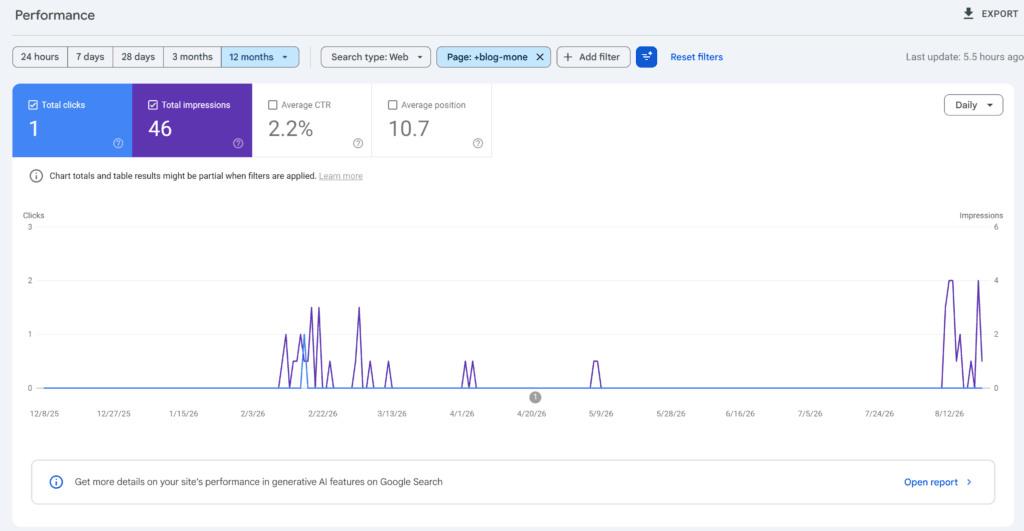
Search Console also showed weak and confused search signals.
One query linked to the page was related to YouTube monetization rather than blogging.
That does not prove one section caused the poor performance.
It does show why adding more explanations was not enough.
Our first AdSense review had already pushed us toward the same conclusion.
Earlier Miura Visual blog articles often explained programmes, platforms and ways to earn.
Much of that information could already be found elsewhere.
So we changed how we approach content.
Each article now needs to help the reader make a decision, fix a problem, run a test, or take a clear next step.
Research still matters, but it should support the article rather than become the article itself.
That is also why this updated article does not try to become another list of 9, 11 or 15 ways to monetize a blog.
More monetization methods were not the missing piece. Better decisions were.
When Should You Use Display Ads?
Display advertising makes more sense once your blog attracts consistent traffic.
Advertising monetises existing attention.
It does not create that attention.
If a page receives almost no visits, adding AdSense will not solve the underlying problem.
For a small website, we would prioritise three things before spending too much time optimising ads:
- Can Google consistently discover the content?
- Are people actually clicking through?
- Are the articles useful enough to keep attracting traffic?
Once those conditions improve, display ads can provide a relatively simple revenue layer.
Do not sacrifice the page for ad space
More ads can create more opportunities for impressions.
They can also make an article harder to use.
That trade-off matters.
A page supporting affiliate sales, service enquiries or another high-value action may be worth more without excessive interruptions.
Use ads to monetise traffic, not to overwhelm it.
You also do not need to wait until advertising becomes worthwhile before every other income route can begin.
When Does Affiliate Marketing Make More Sense Than Ads?
Affiliate marketing deserves more attention when readers are already making product decisions.
Consider these two searches:
Search A: “what is three-point lighting”
Search B: “best compact light for product videos”
Search A mainly asks for information.
Search B contains a potential buying decision.
The second page may have less traffic but still create more valuable affiliate opportunities.
This is why a small blog should not judge every page only by visitor count.
Look for content such as:
- Product comparisons
- Buying guides
- Product alternatives
- Setup guides involving equipment
- Troubleshooting where a product can genuinely solve the problem
The product should appear because it helps the reader make a better decision.
Do not create content around a commission opportunity and then search for a problem to justify it.
Miura Visual uses the opposite sequence:
Buyer problem → Useful content → Relevant product → Tracked action
If product recommendations fit your content, our guide to affiliate marketing in Malaysia covers programme selection, tracked links, validation and commissions in more detail.
For this article, the main rule is simpler:
Ads need attention. Affiliate content needs buying intent.
A blog can eventually use both.
Can You Make Money With a Blog Before It Gets Large Traffic?
Yes, but the income from your blog may come from something other than advertising.
A small specialist website can sometimes create a valuable business action from relatively few visitors.
Consider a photographer who publishes detailed guides, project breakdowns and finished work.
One reader may be looking for photography advice.
Another may realise the photographer offers exactly the service they need.
The second reader could become an enquiry.
The same applies to:
- Video editors
- Designers
- Consultants
- Developers
- Content marketers
- Other specialised service providers
Miura Visual is building its own income structure in a similar order.
Practical creative services can create opportunities before search traffic is large enough to make advertising meaningful.
Affiliate content adds another layer when product-related search intent exists.
SEO content takes longer to drive traffic to your blog.
These income streams do not need to mature at the same time.
Do not wait for an arbitrary traffic milestone if your current visitors already have a clear commercial need.
The trade-off is that service income usually depends on your time and delivery capacity. Advertising can scale differently once traffic grows.
Choose based on what you actually need from the blog.
What If You Have Blog Traffic but Still Make No Money?
Do not immediately assume you need more traffic.
Find the broken step first.
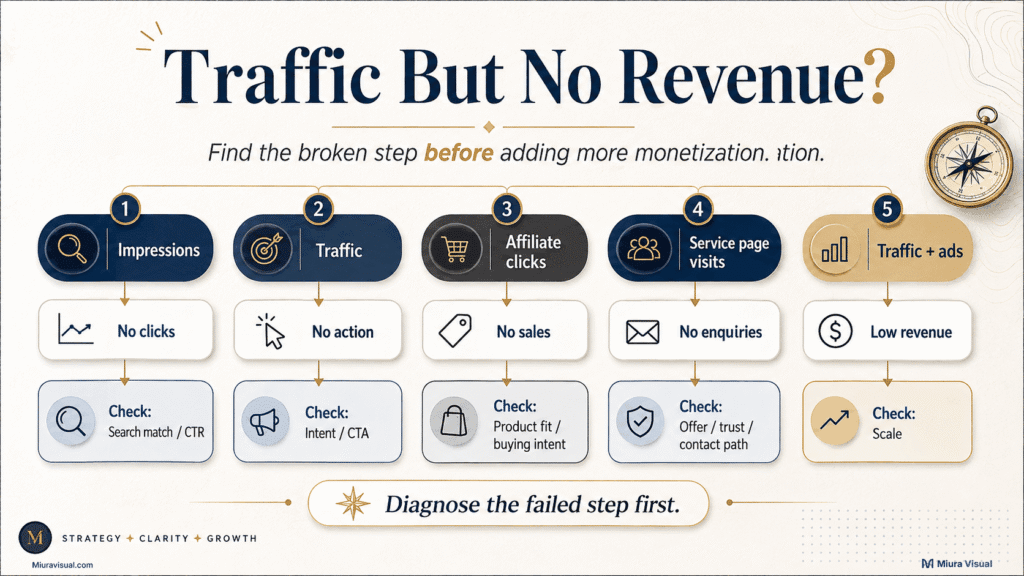
You get impressions but few clicks
The problem is still before monetization.
Check:
- Search intent match
- Title
- Meta description
- Ranking position
- Whether the page answers the query Google is showing it for
More affiliate links will not fix weak search clicks.
You get traffic but no commercial action
The page may attract people who only want information.
That is not necessarily a bad page.
You may need to:
- Use advertising instead
- Add a more relevant next article
- Improve the call to action
- Accept that the page mainly supports traffic and topical coverage
Do not force buying intent where none exists.
You get affiliate clicks but few purchases
Now the problem is further down the journey.
Possible causes include:
- Weak product fit
- Low buying intent
- Price
- Better alternatives elsewhere
- A recommendation that does not answer the reader’s real concern
A click is only one step. It is not the same as a validated commission.
People view service-related content but do not enquire
Check whether the reader can easily understand:
- What you offer
- Who the service is for
- What the next step is
- Where to contact you
- Why they should trust your work
A useful article can prove expertise while still failing to make the service path clear.
You have traffic and ads but very little revenue
Traffic may simply be too low for advertising to matter yet.
Do not respond by filling every available space with more ads.
First decide whether the same traffic has stronger value through affiliate content, services or another suitable action.
The diagnosis matters more than the monetization method.
Run One Blog Monetization Test Before Adding More
Once you find a suitable opportunity, test one route first.
Do not redesign your entire business around it.
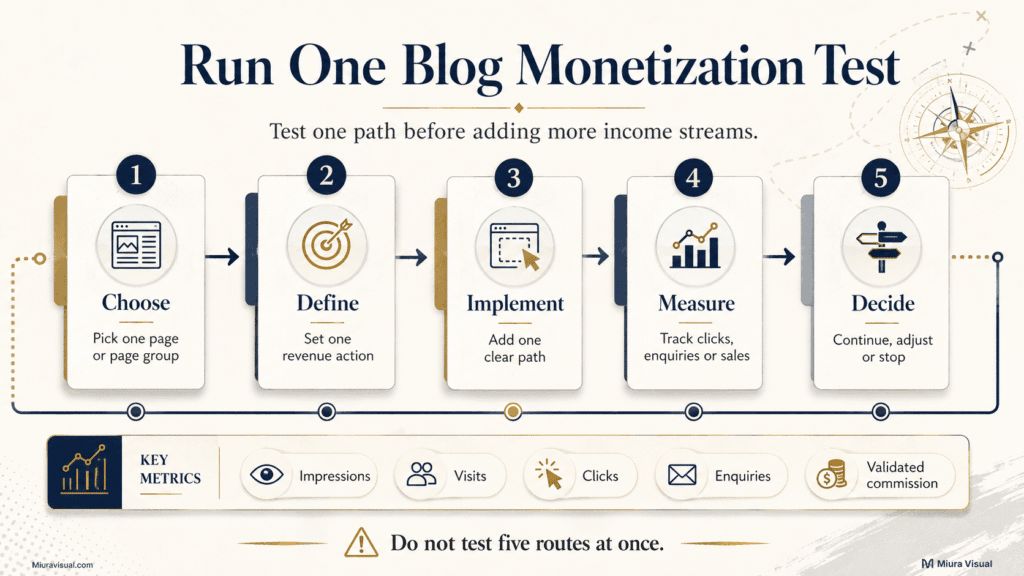
1. Choose one page or page group
Start with content that already has a useful signal.
That could be:
- Search impressions
- Organic clicks
- Consistent visitors
- Product-related queries
- Service-related intent
2. Define one revenue action
Decide what success should look like.
For example:
- Affiliate click
- Validated affiliate sale
- Service enquiry
- Product purchase
For display advertising, monitor traffic and ad performance once the site is eligible and ads are active.
3. Add one clear path
Do not send the same reader toward an affiliate product, service booking, online course and five unrelated articles.
Choose the most relevant action.
4. Measure the journey
Track the stages you can actually observe:
Search impression → Click → Page visit → Commercial action → Result
The exact metrics depend on the monetization method.
For affiliate content, track clicks, orders and validated commission separately.
For services, an enquiry is more useful than a page view alone.
5. Continue, adjust or stop
After collecting enough evidence, choose one of three actions.
Continue when the traffic and commercial action fit each other.
Adjust when readers show interest but stop before the intended result.
Stop or deprioritise when the monetization layer adds little value or does not fit the audience.
A weak test does not always mean you cannot make money from blogging.
The problem may be the page, offer, intent, product or call to action.
Change the part that is actually failing.
Conclusion: Monetize What Your Blog Already Does Well
The most useful way to make money from your blog is not to add the largest number of income streams.
Start with the value your website already creates.
If Google barely discovers your pages, prioritise content and search visibility.
If readers are comparing products, test affiliate content.
If they are evaluating your expertise, give them a clear service path.
Add advertising when traffic becomes meaningful enough to justify it.
Open Search Console and choose one promising group of pages.
Identify why people visit them, define one commercial action, and test that path before adding another monetization method.
Frequently Asked Questions
How many blog posts do I need before I can monetize?
There is no fixed number. Ten useful articles with clear search demand can be more valuable than 100 weak posts. Focus on whether your blog has traffic, useful intent and a suitable monetization path.
How much traffic do I need to monetize a blog?
It depends on the method. Display advertising relies more on traffic volume. Affiliate marketing, products and services can work with smaller audiences when the visitors have stronger commercial intent.
Can You Still Make Money From a Blog Without Google AdSense?
Yes. A blog can earn money through affiliate marketing, services, products and Sponsored posts. AdSense is one possible revenue layer, not a requirement for every blog.
How long does it take to make money blogging?
There is no reliable universal timeline. It depends on how quickly you build useful traffic and whether that traffic connects to a commercial action. Search-led websites can take time to develop, while a service-focused blog may generate an inquiry earlier.
Is affiliate marketing or display advertising better for a small blog?
Neither is automatically better. Display advertising becomes more useful with consistent traffic. Affiliate marketing can make more sense when readers are already comparing products or making buying decisions. Choose based on traffic intent, not commission rates alone.

Miura Visual
Transforming visuals into content, stories, and scalable value across platforms and audiences.
Related Article