Why Miura Visual Updated Old Blog Posts Instead of Writing New Ones
When a content site already has blog posts appearing in Google search results, the next move is not always another new post. Miura Visual reached that point while planning our next content cycle. We used our Search Console data to decide whether to update old blog posts or write new ones.

Quick Answer
For Miura Visual, we chose to update five existing blog posts first.
Our August publishing target was already complete.
Some existing Content Creation articles got search impressions. However, they ranked lower than expected.
That changed the priority.
- Update when a current page meets the search intent and displays helpful signals.
- Write new content when the reader needs an answer that the existing page should not cover.
- Wait when there is not enough data to justify either decision.
This does not prove that updating old content always beats publishing new content. It only explains why updating was the better use of our content capacity in this situation.
What Changed After We Completed Our Publishing Goal
Publishing more articles has been an important part of Miura Visual’s content work.
That made sense while we were building coverage.
A small content library needs useful pages first.
Then, there will be performance improvements.
The situation changed once our August publishing target was complete.
We could keep measuring progress through new URLs.
Or we could look at what our existing articles were already telling us.
The second option became more useful.
Several Content Creation pages were already appearing in Google Search.
They had impressions, relevant topics, and established URLs.
The problem was that many were still outside stronger ranking positions.
At that point, another five articles would increase our publishing count.
They would not automatically improve the pages already showing potential.
So we changed the next priority from:
Publish more → publish more → publish more
to:
Review existing signals → choose recovery candidates → improve those pages first
This was a resource decision, not a rule against new content.
We still create new articles when a genuinely different search need exists.
Our content gap analysis helps us make that distinction before adding another URL.
What Google Search Console Showed About Our Blog Post Rankings
We did not choose five old articles simply because of their age.
We began with pages that had enough search activity for a closer look.
The Search Console snapshot used for this decision showed:
| Existing article | Impressions | Average position |
|---|---|---|
| Photography Workflow | 631 | 14.77 |
| How to Shoot B-Roll | 300 | 17.74 |
| Video Production Workflow | 870 | 22.3 |
| Content Creation Workflow | 548 | 22.52 |
| What Is a Shot List? | 959 | 37.67 |
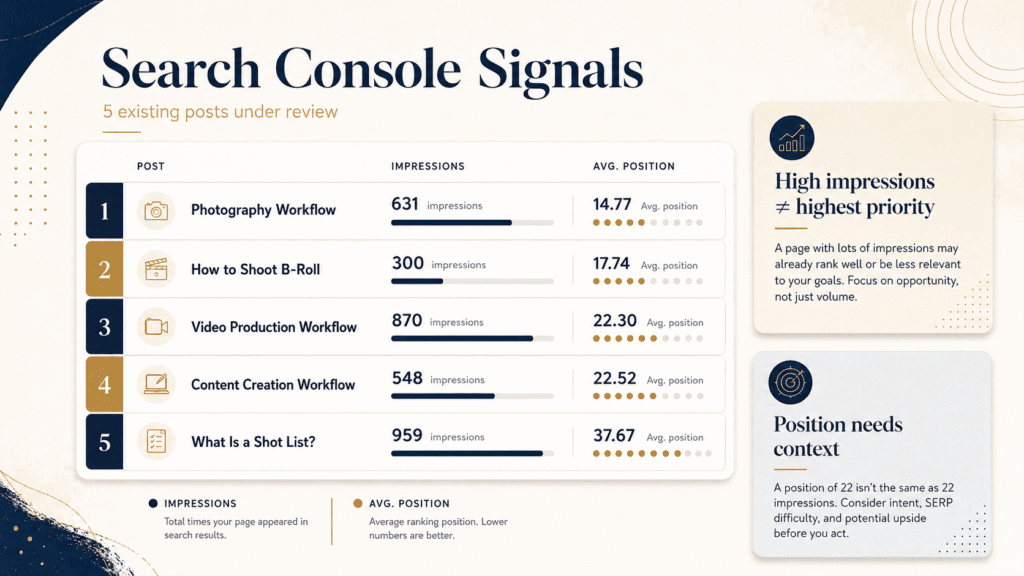
These numbers did not give us one simple answer.
Photography Workflow was already fairly close to stronger first-page visibility.
What Is a Shot List had far more impressions but ranked much lower.
That difference matters.
Impressions show opportunity, not priority by themselves.
The average position also needs context.
A page at position 15 with weak queries isn’t always better.
A page at position 25 can be more valuable if it matches an important topic well.
We treated the table as a starting point for diagnosis.
To decide which posts to update, keep, merge, or leave alone, check our blog content audit.
We just needed enough evidence to pick which pages needed more focus.
Why These Old Blog Posts Had Different Ranking Opportunities
Calling all five pages “underperforming posts” would hide an important difference.
They were underperforming in different ways.
For this review, we grouped them into three practical types.
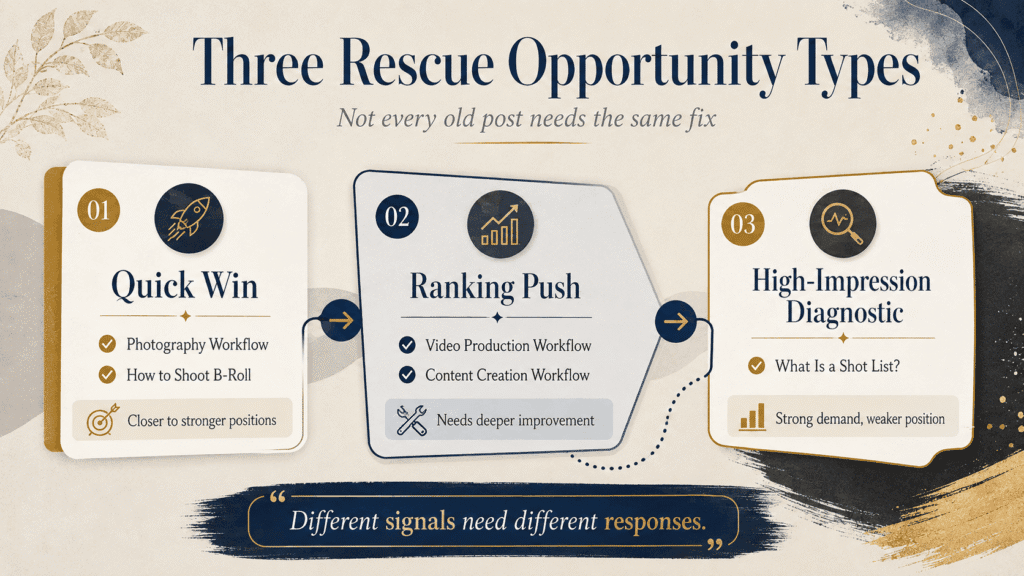
1. Quick-Win Candidates
Photography Workflow — Position 14.77
How to Shoot B-Roll — Position 17.74
These pages were already within reach of stronger positions.
That did not guarantee they would move.
It meant that testing improvements was key.
We should try them before making another page on the same topic.
We needed to check if Google understood the page’s relevance or if it was missing important content.
That question is more useful than simply asking whether the article is old.
2. Ranking-Push Candidates
Video Production Workflow — Position 22.30
Content Creation Workflow — Position 22.52
These pages were further away.
However, both had enough impressions.
This showed that Google was already displaying them for relevant searches.
That made them different from pages with almost no search signal.
They needed a deeper review rather than a quick edit.
The best move was to improve the current page first if the search intent matched.
Making another article for the same issue might just split the content between two URLs.
This won’t really solve the problems with either page.
3. High-Impression Diagnostic Candidate
What Is a Shot List? — 959 impressions, Position 37.67
This was the most interesting case.
It had the highest impressions in the group but the weakest average position.
That does not make it the best quick win.
It makes it a strong diagnostic candidate.
The page was appearing often enough to justify a closer look:
- Are the queries actually relevant?
- Does the page answer the main intent quickly enough?
- Is the content competing against stronger formats?
- Is an important part of the answer missing?
- Does the article need improvement? Or does the ranking distance show a bigger problem?
This is why we did not create one universal rescue score.
Different signals require different responses.
Our three labels are Quick Win, Ranking Push, and High-Impression Diagnostic.
They are categories for this review.
They are not universal SEO classifications.
Why We Updated Old Content Instead of Writing Five New Posts
The decision came down to where the next unit of work could create more value.
All five pages already existed.
They already covered meaningful Content Creation topics.
Search Console also showed some level of demand around them.
That gave us four reasons to prioritise the existing URLs.
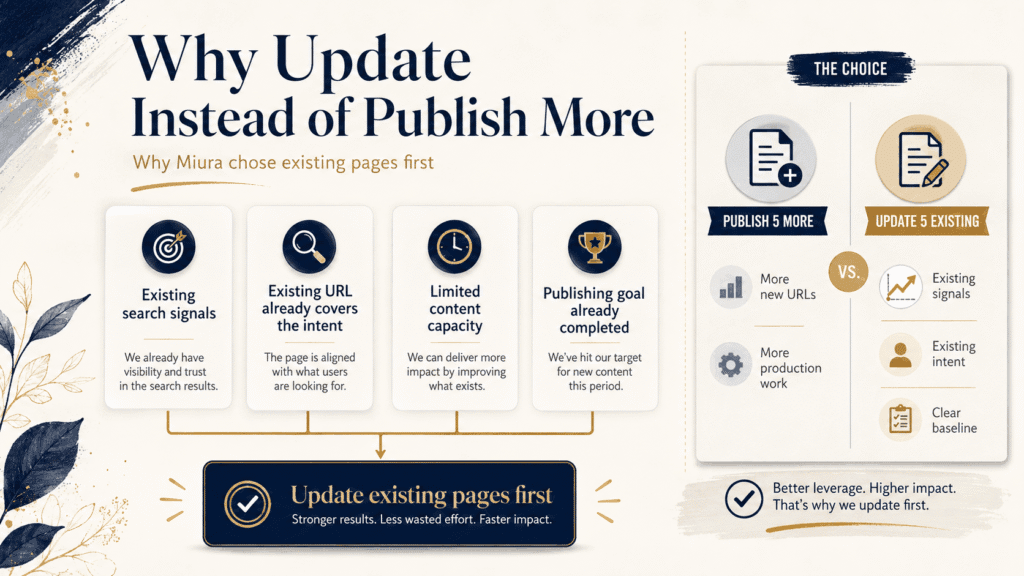
The search opportunity already existed
We were not trying to create demand from nothing.
Google was already displaying these pages.
It doesn’t ensure better rankings, but it gives us a solid point to explore.
The Existing Content Already Covered the Main Topic
A new blog post is useful when a new search intent deserves its own answer.
It’s not helpful if the new article is just another version of something we’ve already published.
We check if the opportunity fits in the current article before opening another URL.
Our blog content workflow separates that decision into Create, Update, Merge, Wait, or Skip.
For these five pages, Update was the next action.
Publishing New Content Would Split Limited Capacity
Every new article requires several steps:
- Research
- Writing
- Editing
- Images
- Internal links
- Publishing
- Review later
These are all important for a strong article.
Updating also takes work.
The difference is where that work goes.
We had existing pages showing signals but not yet reaching the positions we wanted.
Ignoring them while adding more URLs would leave those opportunities unresolved.
Our publishing goal had already done its job
The earlier goal encouraged consistent output and expanded the site’s coverage.
After that work was done, using the same KPI forever would overlook a key part of SEO. It’s important to improve what already exists.
A publishing target should guide production. It shouldn’t stop a change in priority when the evidence shifts.
That was the main reason we stopped treating another five new posts as the automatic next step.
What Did Not Decide Which Posts We Chose
A common mistake in content optimization is relying too much on one metric.
This can affect all your decisions.
We deliberately avoided that.
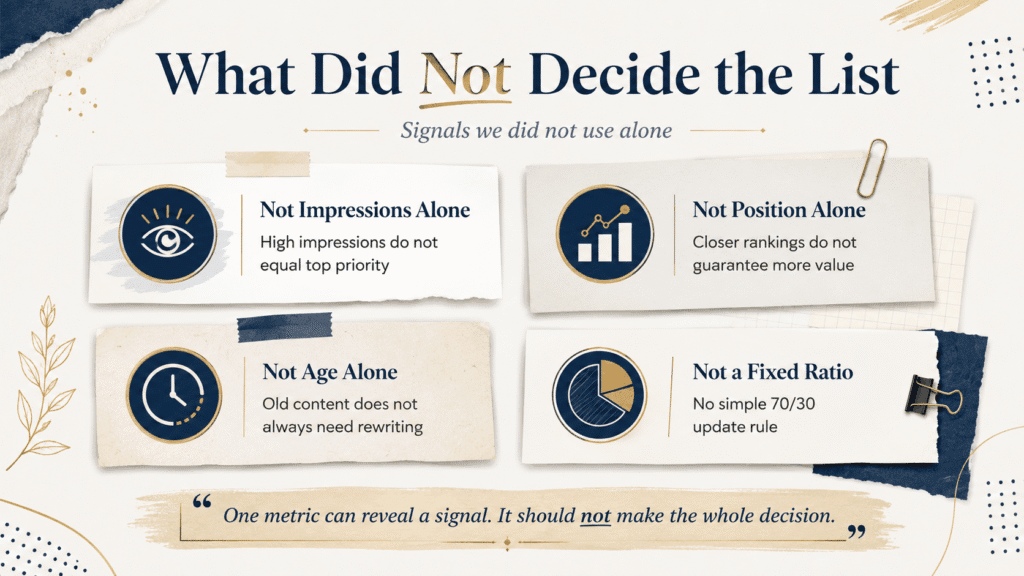
We did not choose by impressions alone
If impressions were the only rule, What Is a Shot List would be the obvious first priority.
It had 959 impressions, the highest of the five.
But its average position was 37.67.
That creates a different problem from Photography Workflow at position 14.77.
One needs a diagnosis. The other may be closer to a ranking push.
We Did Not Choose Posts by Ranking Position Alone
The closest page is not automatically the most valuable page.
Search intent, query relevance, and the role of the article still matter.
A position number cannot tell us whether the current answer is the right answer.
We Did Not Update Old Content Just Because It Was Old
Age can give you a reason to review a page.
It is not a reason to rewrite one.
An older post may need nothing.
A newer article may already need work if it misses the search intent.
We did not use a fixed update-to-new-content ratio
There was no rule such as:
70% updates, 30% new posts.
That kind of ratio can look tidy while ignoring the actual website.
Our decision came from the pages available at that moment.
The practical rule was simpler:
One metric can reveal a signal. It should not make the whole content decision.
How We Will Measure Whether the Five-Post Rescue Worked
Updating the articles is only half the job.
We also need a baseline.
Without one, it’s easy to see a later ranking and think the update “worked.”
But we can’t know what changed.
For each selected page, the useful baseline includes:
- Search clicks
- Impressions
- Average position
- CTR
- Relevant search queries
- The reporting period used for comparison
We can review the measurements after the updated pages have been crawled.
This will give us new search data.
The result does not have to be a clear success.
Improved
Relevant impressions, clicks, or positions move in a useful direction.
That can support further changes or similar work on other pages.
Mixed
Some queries improve while others stay flat or decline.
That may mean the update helped one part of the search intent but not another.
No meaningful change
The page stays close to where it started.
That still tells us something.
It could show stronger competition. It might mean a poor intent match, low authority, or the wrong format. Also, some problems can’t be fixed by content changes alone.
The goal is not to prove the original decision was correct.
The goal is to compare the result with the starting point.
That review can then feed into the next content cycle.
What This Decision Does Not Prove Yet
There is a clear limit to what we can claim from this project.
At this stage, we can show:
- which five pages were selected;
- what search signals they had;
- why we prioritised them;
- how we plan to evaluate the updates.
We cannot yet claim that the rescue work increased rankings or blog traffic.
We also cannot claim that:
- updating old posts always beats writing new ones;
- all five pages will improve;
- five is the ideal number of pages to refresh;
- every site should prioritise positions 11–30;
- Google will reward a page simply because it was updated.
Those claims need different evidence.
An SEO decision can still be reasonable before the result is known.
The useful lesson is not that refreshing old posts always works.
Use the evidence you have.
Decide where to allocate your limited resources.
Then, measure the results.
Conclusion
If an article meets the search intent and has good signals, check that URL first.
Don’t publish another version of the same idea.
If the reader needs a genuinely different answer, create new content instead.
If neither option has enough evidence yet, wait rather than forcing production.
For Miura Visual, the next step was clear: improve these five pages.
They will keep the original baseline and then judge the decision based on the search data that follows.
Frequently Asked Questions
Should you update every old blog post?
No. An old page still needs a useful reason for more investment. Weak demand, irrelevant intent, or little strategic value may make another page a better priority.
When should you update an old blog post instead of writing a new one?
Update the content if the new opportunity matches the same search intent and the current URL is still helpful. Create a new page when the reader is solving a clearly different problem.
Can you update old blog posts and still publish new content?
Yes. Content updating and new publishing can happen together. The real question is which task deserves priority within your available time and resources.
How do you know which old blog posts are worth updating?
Look for posts with relevant impressions, ranking position, useful queries, and a clear role in your content structure. Do not choose pages from one metric alone.
How long should you wait before judging whether a content update worked?
Give the updated page enough time to be recrawled and collect meaningful search data. Then compare it with the same baseline metrics instead of judging the result from a few days of movement.

Miura Visual
Transforming visuals into content, stories, and scalable value across platforms and audiences.