Shopee Affiliate for Bloggers: How to Promote Products with SEO Content
Shopee Affiliate for bloggers works best when your blog helps readers decide what to buy. This guide shows what to write, where to place links, and how to avoid thin affiliate content.

Quick Answer: Can Bloggers Use the Shopee Affiliate Program?
Yes, bloggers can join the Shopee Affiliate Program.
They need a blog, website, or small content site that can send readers to product pages.
But the strategy is different from social media.
A blogger should not just paste Shopee links into random posts.
A better way is to create SEO content that answers buyer questions.
It should compare options and give readers a clear reason to click.
For bloggers, Shopee Affiliate works well. It helps readers decide what to buy.
Useful blog formats include:
- Product reviews
Use this when you want to help readers decide if one product is worth buying. - Buyer guides
Use this when readers need help choosing the right type of product. - Comparison articles
Use this when readers are deciding between two options, budgets, or use cases. - Product lists
Use this when readers want several options for one clear need. - Problem-solution guides
Use this when the product solves a specific problem, like a messy desk, poor lighting, or weak phone audio.
If your blog post helps someone decide, it will get more clicks.
It can also build trust and boost affiliate conversions.
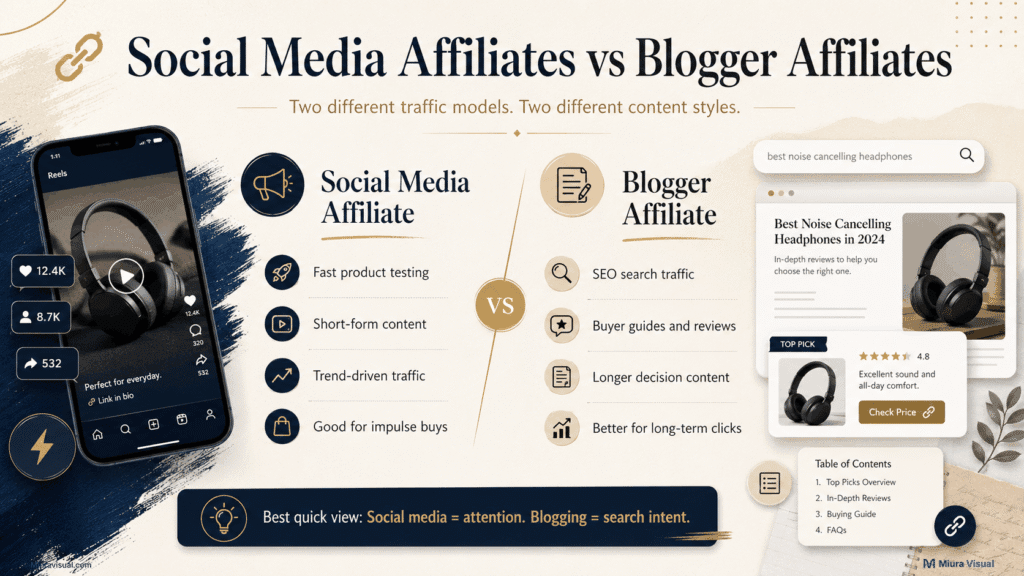
Social Media Affiliates vs Blogger Affiliates: What Is the Difference?
Social media affiliates and blogger affiliates can promote Shopee products.
But their traffic strategies differ.
Social media is usually built on attention.
Blogging is built on search intent.
Social media affiliates are better for:
- fast product testing
- short videos
- impulse buying
- trending products
Blogger affiliates are better for:
- SEO traffic
- buyer guides
- product comparisons
- long-term content
A social media affiliate may post: “Shopee finds under RM30 for your desk setup.”
A blogger may write: “Best phone tripods for beginner content creators in Malaysia.”
Both can work.
But they solve different problems.
If you need fast testing, social media is usually better.
If you want long-term traffic, a blog is more useful.
For a small Malaysian creator site, blogging may start slowly.
However, it can become more stable as articles gain impressions.
How the Shopee Affiliate Program Works for Bloggers
Shopee Affiliate for bloggers works through a simple path.
A reader searches on Google.
They find your blog post.
They read your recommendation.
They click your Shopee affiliate link.
If the user clicks your link and makes a purchase on Shopee, you may earn a commission.
| Step | What Happens | Bloggers Job |
|---|---|---|
| 1 | Reader searches a problem | Target useful keywords |
| 2 | Reader lands on your article | Give a clear answer fast |
| 3 | Reader compares options | Help them decide |
| 4 | Reader clicks Shopee link | Place links naturally |
| 5 | Reader buys | Track clicks and orders |
The important part is decision support.
A blogger should not act like a link spammer.
Your article should answer:
- Who is this product for?
- Who should skip it?
- What should buyers check first?
- Is there a cheaper or better option?
- What problem does this product solve?
This is where many small affiliate blogs fail.
They list products but do not help readers choose.
That creates thin affiliate content.
Pros and Cons of Using a Blog for Shopee Affiliate Marketing
Using a blog for Shopee Affiliate has real advantages, but it is not the fastest method.
It is better for creators who are willing to build traffic over time.
It is weaker for people who want quick results.
Pros of using a blog:
- Long-term SEO traffic
- Better for buyer guides
- Works without showing your face
- Easier internal linking
- Can support AdSense later
Cons of using a blog:
- SEO is slower
- Weak structure will not rank well
- Links and prices can change
- Blog readers compare more
- You still need search intent
The biggest benefit is long-term traffic.
The biggest risk is thin content.
For a small Malaysia creator site, Shopee Affiliate blogging is useful only if the article solves a real search issue.
If the article has no search demand, making it longer will not fix the problem.
If you have a small blog, Shopee Affiliate might not be worth it yet.
You need a clear niche, some search traffic, and a plan to update your product content.
Start with informational SEO first.
Add affiliate links if the page already has impressions or if the topic shows clear buyer intent.
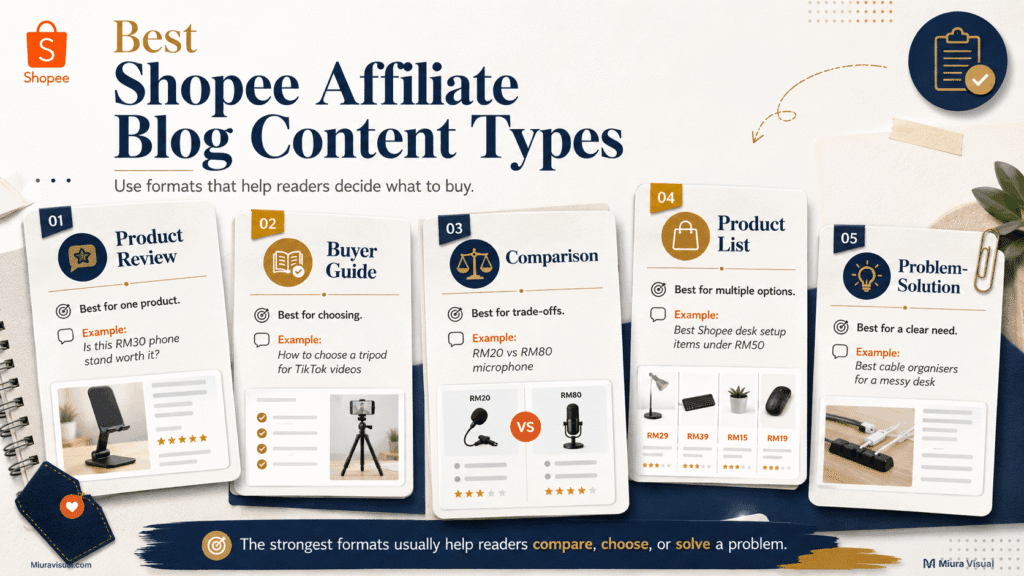
Best Shopee Affiliate Blog Content Types
Not every blog post works for Shopee Affiliate.
The best posts help readers make a buying decision.
| Content Type | Example Title | Best For |
|---|---|---|
| Product review | Is this RM30 phone stand worth buying? | One product |
| Buyer guide | How to choose a tripod for TikTok videos | Product education |
| Comparison | RM20 vs RM80 microphone: which is better? | Budget decision |
| Product list | Best Shopee desk setup items under RM50 | Multiple options |
| Problem-solution guide | Best cable organisers for a messy desk | Clear user problem |
The strongest format is usually buyer guide or comparison.
These formats give you space to explain.
They also let readers understand why one product is better for their situation.
Blog readers are not only looking for products.
They are looking for help choosing.
What Product Categories Work Better for Blog Content?
Some product categories work better for blogs than others.
Good product selection usually starts with a clear problem, clear buyer type, and enough details to explain.
| Product Type | Good for Blog? | Why |
|---|---|---|
| Creator tools | Yes | Readers compare specs and use cases |
| Desk setup items | Yes | Easy to connect with real problems |
| Home organisers | Yes | Strong problem-solution angle |
| Beauty products | Sometimes | Works if you can explain use case carefully |
| Fashion items | Sometimes | Better for visual content than blog |
| Cheap random gadgets | Risky | Easy to become a weak product list |
| Viral products | Risky | Search demand may disappear fast |
Good blog products need search demand.
They should also need some explanation.
For example, a phone tripod can work well because people compare height, stability, price, and use case.
A random RM5 gadget may look fun, but it may not deserve a full blog post.
For Miura Visual-style content, choose topics that inspire action.
Don’t just share information.
For e-commerce affiliate content, a product is worth writing about when the reader needs help deciding.
How to Place Shopee Affiliate Links in a Blog Post
Shopee affiliate links should feel useful, not forced.
The best placement depends on the article type.
| Link Placement | Best Use | Mistake to Avoid |
|---|---|---|
| Product section | After explaining one product | Linking before giving value |
| Comparison table | When comparing options | Too many buttons |
| “Where to buy” line | After a clear recommendation | Hiding the link too deep |
| Final recommendation | At the end of the guide | Repeating the same CTA too often |
| Related guide box | When sending readers to another article | Linking to unrelated content |
A good link placement gives context.
A weak link placement interrupts the reader.
Do not put affiliate links everywhere.
Use them when the reader has enough information to act.
Also make it clear when a link is an affiliate link.
A clear disclosure builds trust. It lets readers know you might earn a commission.
You do not need to make it complicated.
A short line like “This post may contain affiliate links” is enough for most blog posts.
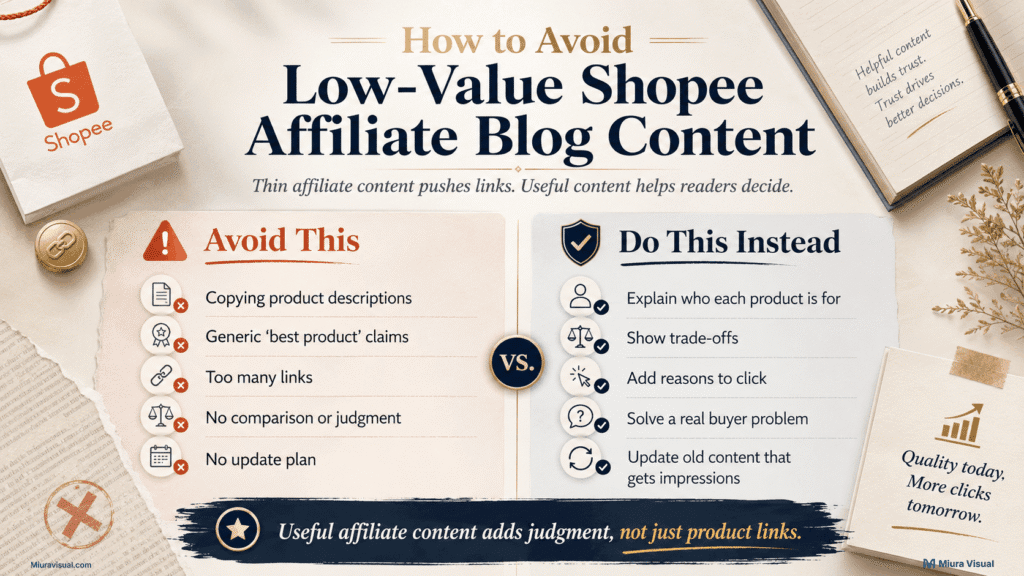
How to Avoid Low-Value Shopee Affiliate Blog Content
This section matters most.
Shopee Affiliate blog content becomes low value when it only repeats product information.
Google does not need another page that copies Shopee listings.
Readers do not need that either.
❌ Avoid these mistakes:
- Do not copy Shopee product descriptions.
- Do not list products without explaining why they matter.
- Do not use generic “best product” claims.
- Do not add affiliate links everywhere.
- Do not recommend products without comparing options.
- Do not ignore buyer concerns.
- Do not leave product articles outdated for too long.
The main mistake is copying descriptions.
The better move is adding judgment.
✅ To make the content useful, add:
- Who should skip it
- What problem it solves
- What buyers should check before buying
- What makes one option better than another
- Is there a cheaper option?
- Is there a better option?
- What the more expensive option improves
For a small website, this is where you can compete.
You may not beat big sites with authority.
You can make weak content stronger.
Use better judgment.
Give clearer examples.
Include specific use cases.
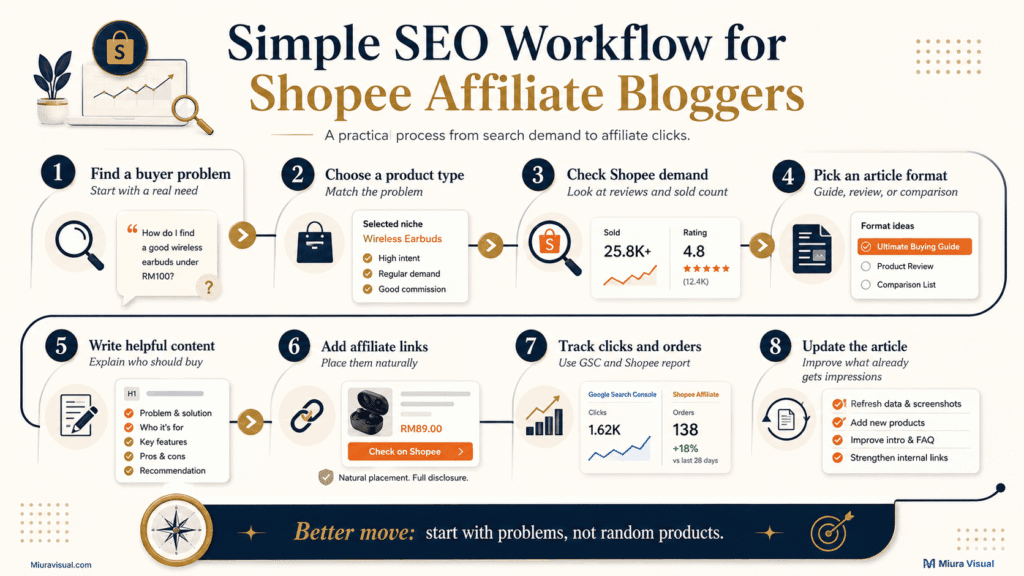
Simple SEO Workflow for Shopee Affiliate Bloggers
A blogger needs a simple workflow.
Do not start by picking random products.
Start with the reader’s problem.
A simple blogging workflow looks like this:
- Start with a buyer problem.
Example: “My desk is messy.” - Choose a product category that solves it.
Example: cable organiser, storage box, monitor stand, or desk tray. - Check Shopee demand.
Look at sold count, reviews, price range, and product quality. - Choose the right article format.
Use a buyer guide, comparison, product list, or problem-solution article. - Write decision-focused content.
Explain who should buy, who should skip, and what to check first. - Add affiliate links naturally.
Place links after useful context, not before. - Track the result.
Check Google Search Console impressions, page clicks, your affiliate dashboard, Shopee clicks, orders, and conversion. - Update the article.
Replace weak products, improve sections, and add better examples.
The key is problem first.
The product comes after.
This looks slower, but it saves time.
Many beginners waste effort writing about products nobody searches for.
If a page gets impressions but no clicks, improve the title and intro.
If a page gets clicks but no Shopee clicks, improve the product section and CTA.
If a page gets Shopee clicks but no orders, the product choice may be weak.
Example Shopee Affiliate Blog Content Plan
A good Shopee Affiliate blog should not only write product lists.
It should mix guides, comparisons, and problem-solving content.
| Article Idea | Search Intent | Best Product Type |
|---|---|---|
| Best Shopee items for small desk setup | Product list | Desk tools |
| Best phone tripods for beginner creators | Buyer guide | Creator gear |
| Ring light vs desk light for TikTok videos | Comparison | Lighting |
| Best cable organisers for home office | Problem-solution | Home office items |
| Budget Shopee tools for filming Reels | Product list | Creator tools |
| How to choose a microphone for phone videos | Buyer guide | Audio gear |
| Best Shopee storage ideas for small rooms | Problem-solution | Home organisers |
| Cheap vs expensive phone stand | Comparison | Phone accessories |
For creator, photography, or small content sites, you can make the plan more specific:
- Best budget lights for product photography
- Best phone tripods for filming Reels
- Best desk setup items for content creators
- Best Shopee tools for beginner photographers
- Best storage items for camera accessories
This kind of plan works because each article has a different job.
Some attract search traffic.
Some help readers compare.
Some send readers to product pages.
Some support internal links.
For a small content site, the goal is not to publish random Shopee lists.
The goal is to build a small content system that helps readers move from problem to product.
Conclusion: Is Shopee Affiliate Worth It for Bloggers?
Shopee Affiliate is great for bloggers.
It helps build SEO traffic and lets you create useful product content.
It is not worth it if you only want fast money.
It is also not worth it if you plan to publish thin product lists with no judgment.
Choose the blogger route if you can:
- Write buyer guides
- Compare products clearly
- Update old articles
- Build internal links
- Track what gets clicks
- Help readers decide
Skip this route if you:
- Do not want to write
- Do not want to update links
- Only want instant income
- Have no topic strategy
- Plan to copy product descriptions
The best move is slow build.
Use blog content for search traffic.
Use social media for faster product testing.
Use Shopee reports to see what people actually click.
That combination is stronger than relying on only one channel.
Frequently Asked Questions
Can I use a blog to join the Shopee Affiliate Program?
Yes. You can use a blog or website for Shopee Affiliate. It should attract readers and direct them to Shopee via affiliate links.
The blog should provide useful product recommendations, not random links.
What type of blog posts work best for Shopee Affiliate?
The best types include:
- Product reviews
- Buyer guides
- Comparisons
- Product lists
- Problem-solution articles
problem-solution articles.These formats help readers decide what to buy.
Where should I place Shopee affiliate links in a blog post?
Place links after useful context.
Good placements are:
- Product sections
- Comparison tables
- “Where to buy” lines
- Final recommendations
Avoid adding links before explaining why the product matters.
Can Shopee Affiliate blogs earn commission without social media accounts?
Yes, but it usually takes longer.
A blog can get traffic from Google search, but SEO needs time.
Social media can help test products faster.
For small creators, using both is usually stronger.
How do I avoid low-value Shopee Affiliate blog content?
Do not copy product descriptions or publish generic product lists.
- Include buyer judgment and comparisons.
- Provide examples.
- List pros and cons.
- Discuss product fit.
- Offer clear reasons to click.
Useful content helps readers decide.

Miura Visual
Transforming visuals into content, stories, and scalable value across platforms and audiences.