Why Was My Shopee Account Banned and How Can I Appeal?
Shopee Affiliate banned or restricted? You are probably trying to figure out what went wrong and what to do next. This guide explains common reasons for bans. It also covers account stages, appeal steps, and tips to avoid future violations.
Quick Jump: Start Here Based on Your Situation
If your Shopee Affiliate account has issues, begin with the section that fits your case.
- Already banned?
Go to How to Appeal for Your Shopee Affiliate Account - Only got a warning?
Go to How Problems Usually Escalate - Not sure whether it is really a ban?
Go to Are You Actually Banned or Just Restricted? - Need to appeal now?
Go to What to Include in Your Shopee Affiliate Appeal - Want to avoid future violations?
Go to How to Prevent Shopee Affiliate Violations in the Future
If you are here because you are panicking, start with your current status first.
That will save you the most time.
Quick Answer: Why Shopee Affiliate Accounts Get Banned
Shopee Affiliate accounts usually get into trouble for one reason.
The promotion stops looking trustworthy.
This often occurs when the account shows spammy, misleading, risky, or fake behavior.
In most cases, the problem comes from one of these:
- spamming affiliate links
- posting low-quality or misleading promotional content
- using content that looks fake, copied, or irrelevant
- promoting products in the wrong way
- trying to force clicks instead of helping people buy
- using suspicious traffic methods or showing suspicious affiliate behaviour
Most people think the problem is “the platform is strict.”
Usually, the real problem is simpler: the promotion method stopped looking trustworthy.
If you want the full breakdown, jump to Common Reasons Shopee Affiliates Get Banned.
First, Are You Actually Banned or Just Restricted?
Not every Shopee Affiliate problem means the same thing.
Some accounts only get a warning.
Some are temporarily restricted.
Some are fully banned.
Before you do anything else, figure out which situation you are actually in.
This matters because the next step is not the same for every case.
If you only got a warning, the priority is cleanup.
If you were fully banned, the priority is appeal.
If the status is still unclear, the priority is diagnosis first.
Common Reasons Shopee Affiliates Get Banned
Most Shopee Affiliate bans do not happen randomly.
In most cases, the account starts showing the same few risky patterns again and again.
The table below shows the most common reasons. It includes what they usually look like and what those behaviors may signal.
Most people do not get banned because of one dramatic mistake.
This occurs when the promotion style appears weak or risky. It can seem untrustworthy over time.
That is also why warning signs matter. If the same pattern continues, the problem can escalate.
How Problems Usually Escalate
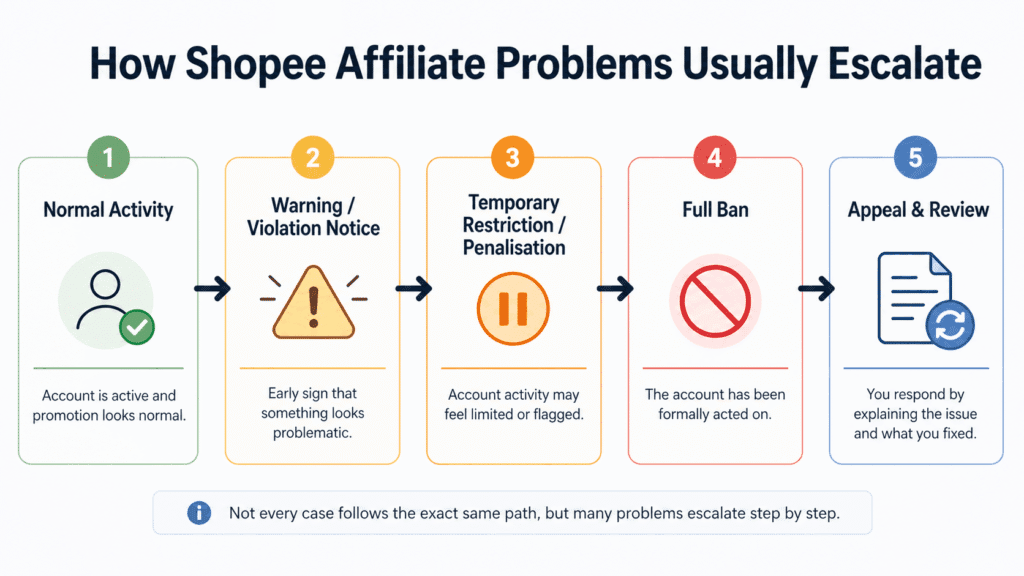
Many Shopee Affiliate problems get worse step by step, not all at once.
If you understand the stage you are in, it becomes much easier to know what to do next.
Most people do not lose their account because of one dramatic mistake.
They lost it because they ignored the early stage.
The same weak behavior continued, making the account a bigger risk.
How to Appeal for Your Shopee Affiliate Banned Account
If your account was already banned, do these 5 things first.
1. Stop the risky promotion
Stop posting the same links, captions, or content style that may have caused the issue.
2. Check what likely caused it
Review your recent posts, links, and traffic sources. Look for spammy, misleading, or repetitive promotion.
3. Prepare your details
Get your account details, affected content, and the changes you already made.
4. Submit a clear appeal
Explain the likely issue, what you fixed, and ask for a review. Keep it short and professional.
5. Wait without repeating the mistake
Do not continue the same risky behaviour while waiting for the result.
What to Do Based on Your Situation
This section does not only apply to blog posts.
It covers all Shopee Affiliate promotion activity.
This includes social media content, websites, messaging channels, and link placements.
If you only got a warning
- Review your recent Shopee Affiliate content and link placements
- Stop risky promotion before the issue gets worse
- Remove content that clearly looks weak or spammy
- Fix the behaviour that likely triggered the warning
If your account looks temporarily restricted
- Check what changed in your recent promotion activity
- Stop the risky pattern before it escalates further
- Remove weak, repetitive, or low-trust promotional content
- Prepare to explain the issue if needed later
If your account was fully banned
- Stop normal promotion and review the likely cause
- Check your recent content, links, and traffic methods
- Prepare a clear appeal based on what happened
- Explain what you already fixed or removed
If you are not sure whether it is a ban
- Check whether it is actually just a warning
- See whether the account is still under review
- Rule out approval or verification-related account issues
- Check for tracking, payout, or link-related problems
The next step should match the status you are actually dealing with.
If you get that part wrong, the rest usually becomes harder.
What to Include in Your Appeal
A clean appeal usually needs five things:
- Your Shopee Affiliate account details
- A short explanation of what happened
- The likely cause or policy issue you identified
- Relevant evidence for your appeal
- A clear request to review or reactivate your account
Do not turn the appeal into a long story.
A good appeal is clear, specific, and easy to review.
Mistakes to Avoid After a Shopee Affiliate Banned
When a Shopee Affiliate account gets banned, many people react too fast. This often makes the situation worse.
The goal at this stage is not to do more.
It is to avoid actions that create more risk or weaken your appeal.
Do not do these:
- do not keep spamming affiliate links
- do not repost the same weak content again
- do not write a vague appeal with no self-check
- do not pretend you have no idea what happened if the pattern is obvious
- do not think opening more accounts solves an account ban or trust problem
These actions usually do not help.
In most cases, they only make the account behaviour look weaker, riskier, and harder to defend.
How to Prevent Shopee Affiliate Violations in the Future
The goal is not only to recover.
The goal is to avoid repeating the same problem again.
Most affiliate problems do not begin with one dramatic mistake.
They usually come from repeated weak decisions that looked small at the time.
Conclusion: What Should You Do If Your Shopee Affiliate Account Gets Banned?
What Should You Do If Your Shopee Affiliate Account Gets Banned?
Start with diagnosis.
- Find the likely reason.
- Stop the risky behaviour.
- Clean up the weak parts.
- Then appeal clearly.
Most Shopee Affiliate banned do not begin with one dramatic mistake.
They usually begin with repeated low-trust behaviour that looked harmless at first.
That is why the best prevention is not fear.
It is quality.
Frequently Asked Questions
Why was my Shopee Affiliate account banned?
Usually because the promotion style looked spammy, misleading, risky, or non-genuine. Common issues include link dumping, clickbait, weak content, bad placement, and suspicious behavior.
Can I appeal a Shopee Affiliate banned?
Yes, you should appeal after finding the cause and stopping the bad behavior first.
Is a Shopee Affiliate banned always permanent?
Not always. Some people confuse warnings, restrictions, and full bans. That is why you should diagnose your actual status first.
What is the difference between a warning and a ban?
A warning is an early signal. A ban is a stronger account action. The response should be different.
How can I avoid getting banned again?
Promote with context. Avoid spam and misleading claims. Use clear content angles. Also, take early warning signs seriously.

Miura Visual
Transforming visuals into content, stories, and scalable value across platforms and audiences.