How We Built a Reusable Service Page Structure
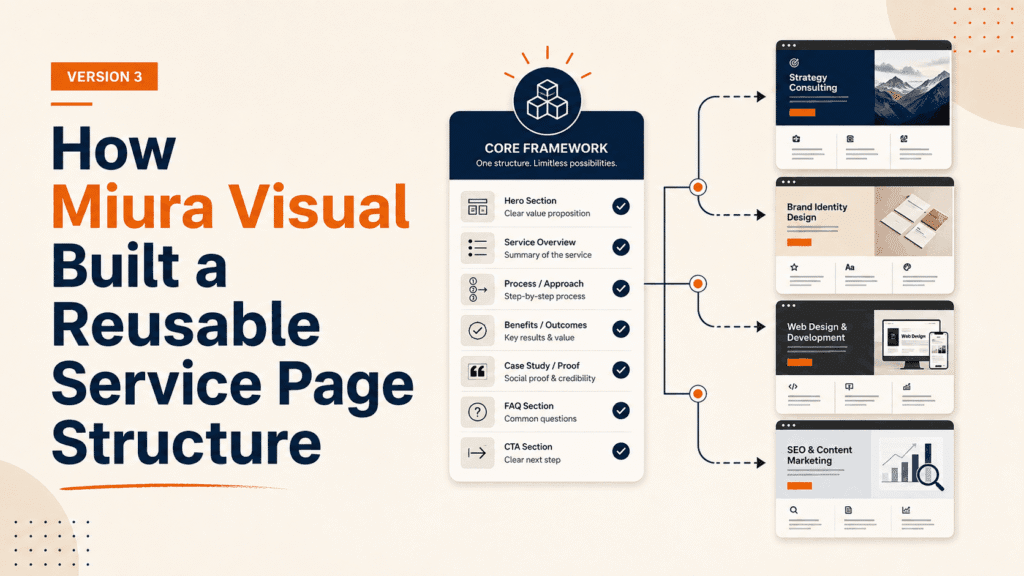
When a website offers different services, one template can make every page feel the same. We needed a service page structure that kept Miura Visual consistent. But we didn’t want to force every service into the same mold.
Quick Answer
A reusable service page should focus on what the page needs to achieve, not on every heading or section.
Keep the same basic flow when visitors are making a similar buying decision.
Change the structure when a service adds new risks.
Also, update it for new responsibilities, scope, commercial terms, or proof requirements.
For Miura Visual, this means having one common base.
Then, we add sections for specific services where buyers need them.
Why We Needed One System Across Very Different Service Pages
Miura Visual does not have just one type of service.
We offer 11 services. They include website work, visual production, editing, affiliate content, and collaboration.
We offer:
- Website Design
- Landing Page Design
- SEO Setup
- Website Maintenance
- Photography
- Videography
- Graphic Design
- Photo Retouching
- Video Editing
- Affiliate & Referral Content
- Brand Collaboration
That created a practical problem.
Starting every page from a blank canvas would make the website harder to build and maintain.
But copying one page, changing the service name, and publishing it again would not work either.
The wider website structure had already been organised around three core service pillars.
That decision clarified where each service belongs. It didn’t define what each service page should include.
We cover that earlier decision in our guide to organising website services.
Once those individual services existed, we needed another system underneath them.
The goal was simple:
- give every service page a clear starting structure;
- make the site easier to maintain;
- keep the visitor journey familiar;
- allow each service to answer its own buying questions.
Consistency was useful. Uniformity was not.
What We Standardised Across Our Service Page Structure
We did not standardise exact headings.
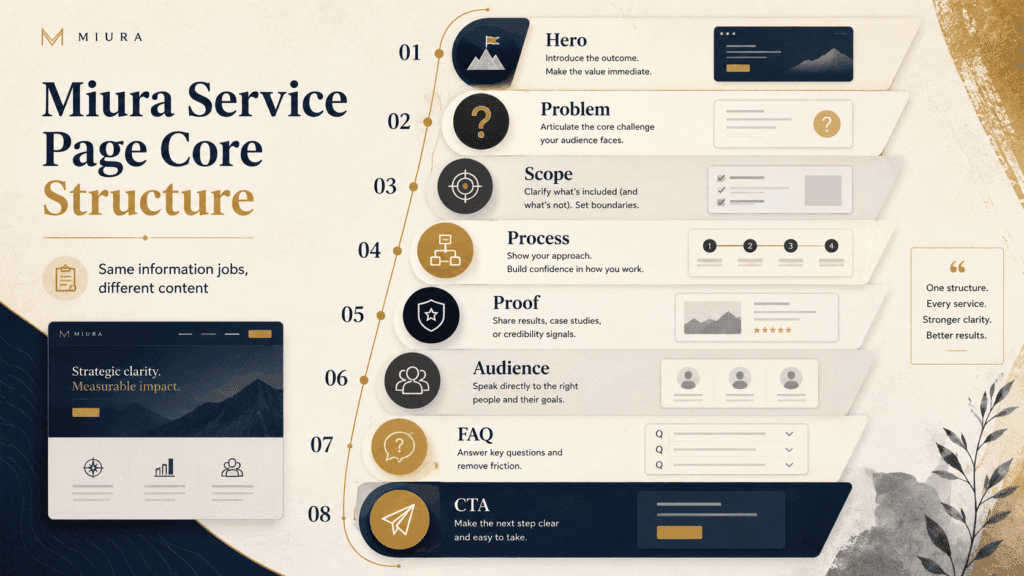
We standardised the main information jobs each page needed to complete.
A typical Miura Visual service page needs to help someone move through a clear sequence:
| Page job | What the visitor needs to understand | Usually reusable? |
|---|---|---|
| Introduce the service | What is being offered and who it is for | Yes |
| Establish the problem | Why someone may need this service | Yes |
| Explain the scope | What the service actually covers | Yes |
| Show the process | What happens after they enquire | Yes |
| Reduce uncertainty | Why the service may or may not fit | Yes |
| Clarify the audience | Who the service works best for | Yes |
| Answer final questions | Important objections or boundaries | Yes |
| Provide a call to action | What the visitor should do next | Yes |
| Explain special terms | Pricing models, risks, rights, exclusions or responsibilities | Depends |
This gave us a reusable service page template without making every page identical.
For example, our Website Design service moves from the website problem into planning, development, responsive setup, SEO foundations, project scope, workflow, suitability, and enquiry.
The overall flow stays consistent, but the details are specific to a web design project.
That distinction became important:
Reuse the purpose of a section. Do not automatically reuse its content.
A process section should explain the process.
It does not mean every service needs the same six steps.
An FAQ should reduce uncertainty.
It does not mean every page needs the same questions.
A scope section should define what the customer gets.
It does not mean every service can explain scope in the same way.
What We Deliberately Changed From Service to Service
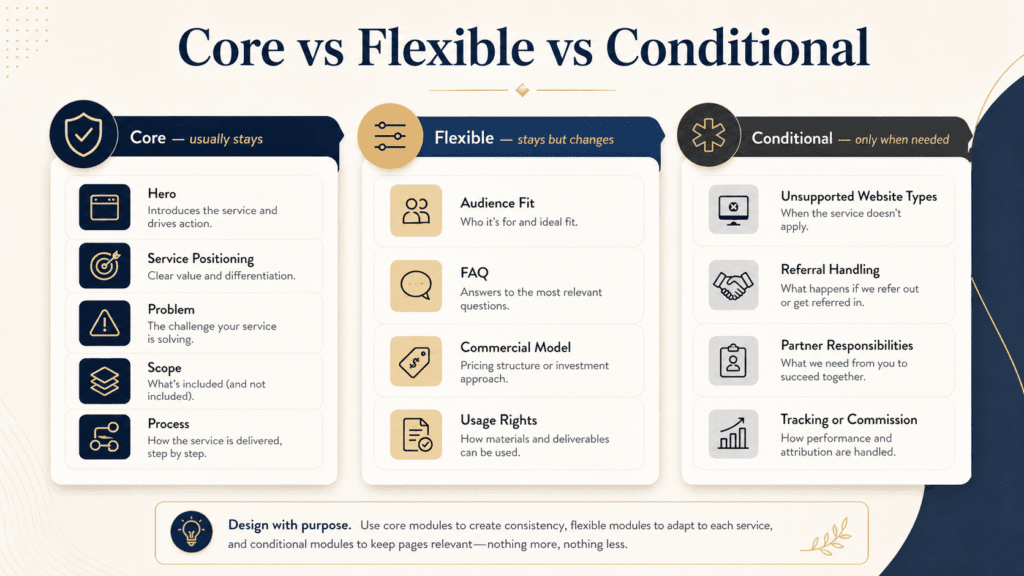
Once the shared structure was in place, we separated page elements into three groups:
Core elements usually stay.
Flexible elements stay but change heavily.
Conditional elements only appear when the service creates a specific need.
A simple version looks like this:
| Element | Core | Flexible | Conditional |
|---|---|---|---|
| Hero and service positioning | ✓ | ||
| Customer problem | ✓ | ||
| Service scope | ✓ | ||
| Process | ✓ | ||
| Audience fit | ✓ | ||
| FAQ | ✓ | ||
| Commercial model | ✓ | ||
| Usage rights | ✓ | ||
| Unsupported website types | ✓ | ||
| Referral handling | ✓ | ||
| Partner responsibilities | ✓ | ||
| Tracking or commission | ✓ |
This avoids a common mistake: treating visual consistency as content consistency.
Two pages can share:
- Typography
- Spacing
- Card styles
- CTA patterns
- Overall page flow
They can still need very different information.
The key factor is the visitor’s buying decision. It’s not about how well the content fits into an existing design.
When a service changes what visitors need to know or decide, the page structure may need to change, too.
If the answer is yes, the page may need to change.
This also keeps individual service-page planning separate from whole-site architecture.
Page hierarchy, navigation, and the relationship between services belong at the website-planning level.
An individual service page should guide website visitors to understand and evaluate that offer.
Four Real Service Page Examples That Forced the Structure to Change
Comparing services in different buying situations made the differences clearer.
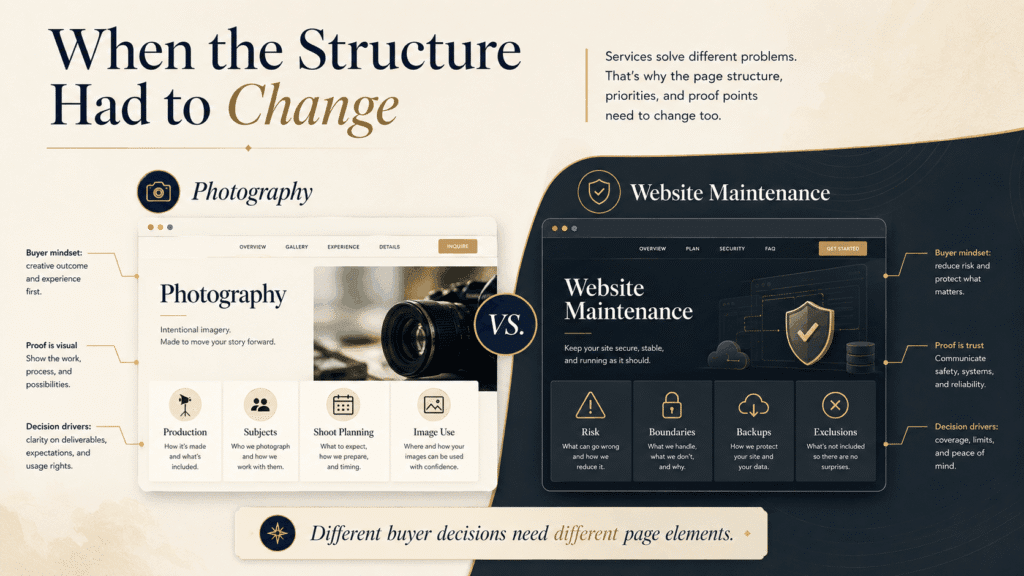
Photography: The Buyer Needs to Understand the Production
A photography customer should know what can be photographed.
They need to understand how the shoot works and how they can use the final images.
Those questions shape our Photography Services page.
The page addresses various photography needs.
It includes subjects, projects, production factors, and intended uses.
This approach goes beyond a standard service template.
The core service-page flow still works.
But the content needs to help someone picture the actual production.
Explaining what can be photographed is better than a generic “benefits” section.
It also helps to clarify what the project involves.
Website Maintenance: The Buyer Needs to Understand Risk and Boundaries
Website maintenance creates a very different decision.
The customer is giving someone responsibility for an existing website.
That introduces technical risk, existing problems, plugins, backups, hosting conditions, and work outside the service scope.
Our Website Maintenance service therefore needs clearer boundaries.
The current service has gaps. It does not cover:
- WooCommerce stores
- Custom-coded websites
- Membership platforms
- Advanced payment functions
- Hacked-site recovery
- Other high-risk sites
That information is not a side note.
It helps visitors decide whether the service is suitable before making an inquiry.
A photography page does not need that type of technical exclusion section. A maintenance page does.
Affiliate Content: The Buyer Needs to Understand the Commercial Model
Affiliate work changes the structure again.
For affiliate work, the content itself is only part of the decision.
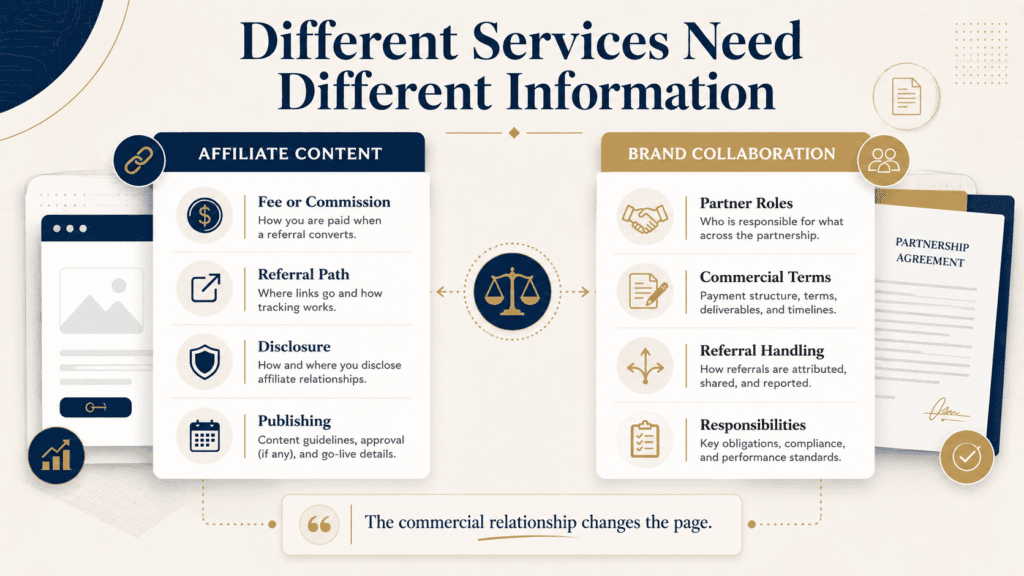
A brand may also need to understand:
- where the content could appear;
- whether the arrangement uses a fee or commission;
- how referrals are tracked;
- what promotional pathway is involved;
- how commercial relationships are disclosed.
Our Affiliate & Referral Content service includes info that wouldn’t fit well on a regular production page.
The existing service also separates commission, fixed-fee, hybrid, and other collaboration arrangements.
The page still has a service scope, workflow, audience, FAQ, and next step.
But its conditional modules are different because the commercial relationship is different.
Brand Collaboration: Both Sides Have Responsibilities
A partnership page pushes the structure even further.
There may not be a normal client-provider relationship at all.
Both sides may contribute services, customers, audiences, venues, content, promotion, or other resources.
Our Brand Collaboration page needs to outline:
- Partner roles
- Commercial terms
- Referral handling
- Content responsibilities
- Brand usage
- Review arrangements
That would be excessive on a normal photography page.
For a partnership, it is part of the buying decision.
These four pages led us to a useful rule:
Change the page only when the decision changes, not just when the service name changes.
When Should You Break a Service Page Template?
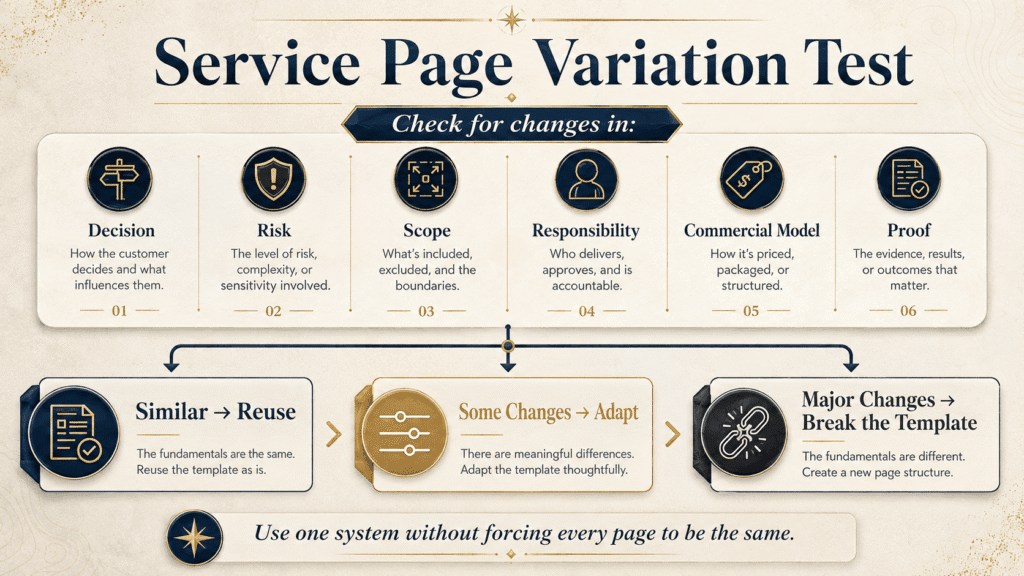
Before adapting a reusable service page layout, check six things.
We use these as a practical Service Page Variation Test.
1. Check whether the buying decision changes
A photography buyer may be deciding whether the team can produce the required images.
A partnership prospect may be deciding whether both businesses are compatible.
Different buying decisions need different information.
2. Compare the level of risk
Website maintenance carries technical responsibility.
Photography involves production and usage considerations.
Affiliate work introduces commercial disclosure and performance uncertainty.
When the risk changes, the page should address it.
3. Check how the scope is defined
Some services have fairly clear deliverables.
Others depend on website condition, project complexity, campaign requirements, or collaboration terms.
Don’t fit variable services into a fixed package if it confuses the scope.
4. Identify who holds the responsibility
A normal service may mainly explain what the provider delivers.
A collaboration may need to define what both sides must contribute.
That difference may require its own module.
5. Check whether the commercial model changes
One service may use straightforward project pricing.
Another may involve commissions, referral fees, or hybrid arrangements.
The pricing section should reflect that difference.
6. Match the proof to the decision
A photography customer may want visual work.
A website customer may want completed websites.
A maintenance customer may care more about process, checks, and service boundaries.
Use the type of proof that helps the visitor verify the service.
Use this decision rule
If all six areas remain similar, reuse the structure.
If one or two areas change, adapt the relevant modules.
If multiple areas change, stop using the template. Adjust the page to fit the new buying decision.
The framework should save work without limiting what the page needs to explain.
Where Reusable Service Page Templates Go Wrong
The problem with templates is rarely the template itself.
The problem starts when consistency becomes more important than explaining the service.
Watch for these signs.
Only the Service Name Changes, Not the Page Content
If you can change “Photography” to “Videography” and most paragraphs still work, the page may not be specific enough.
Each service should answer questions that only make sense for that service.
Every FAQ is nearly identical
Pricing, turnaround, scope, location, access, revisions, and ownership can differ by service.
Keep the FAQ focused on the uncertainty left after reading that page.
Every “Why Us” section says the same thing
Generic claims such as “professional,” “reliable,” and “high quality” add little when repeated across the site.
Use work examples and strengths that matter to that buying decision.
When a Service Page Layout Creates Filler
A six-card layout does not mean you need six useful points.
If you only have four meaningful points, use four.
Do not write content to complete a layout.
Every Page Uses the Same Testimonials and Case Studies
Not all services value testimonials, portfolios, case studies, processes, and technical boundaries equally.
Use the type of proof that reduces uncertainty.
When SEO Starts Controlling the Service Page
Semantic terms can help confirm what people expect to find.
They should not decide which sections exist.
If a section only exists to fit another keyword but does not help the visitor decide or act, remove it.
An effective service page structure should make the offer clearer first.
What This System Has — and Has Not — Proven
Our website shows that diverse services can share a framework. They don’t need identical pages.
We can also show where the framework changes.
Photography, website maintenance, affiliate content, and brand collaboration need different info. Their buying choices are not the same.
What we cannot claim is just as important.
We still need more performance data to see if this structure improved conversions.
The same limitation applied when we documented the earlier service-hierarchy restructure.
We have not shown that:
- enquiries increased because of this structure;
- search rankings improved because of it;
- visitors prefer this layout;
- This is a universal high-converting service page template.
Those claims would need different evidence.
For now, this is an operating framework.
It keeps related pages consistent. It also allows different services to explain what matters.
That is useful without turning the framework into a conversion claim.
Conclusion: Build a System, Not a Clone
If your service pages answer similar buyer questions, start with one shared structure.
You do not need to redesign every page from scratch.
If the risk, scope, responsibility, commercial model, or proof changes, adjust that section.
If several of those factors change, stop forcing the template.
The most practical next step is to audit your existing pages using three labels:
Core — keep it.
Conditional — adapt it.
Unnecessary — remove it.
A reusable structure should make your next service page easier to build.
It should never make a different service harder to understand.
Frequently Asked Questions
Should every service page use the same structure?
No. Use the same foundation when visitors need similar information. Change the structure if the service causes new risks. Also, adjust it for new questions, responsibilities, or buying choices.
How long should a service page be?
Make it long enough to help someone understand the offer and decide what to do next. A complex service usually needs more explanation than a simple one.
Do not add sections only to reach a target word count.
Should every service page include testimonials?
No. Add testimonials when they provide relevant proof. If you lack helpful service-specific testimonials, consider using another type of evidence. That could include portfolio work, process details, scope clarity, or real examples.
Should pricing appear on every service page?
Not always. Show pricing when it helps someone decide and the pricing is clear. For highly variable services, explaining what affects the quotation may be more useful.
How often should service pages be updated?
Update them when the actual service changes.
Check the page if you change the scope, workflow, pricing model, audience, proof, exclusions, or common customer questions. Avoid rewriting a useful page only to make it look “fresh.”

Miura Visual
Transforming visuals into content, stories, and scalable value across platforms and audiences.