How Content Creators Make Money in Malaysia? From Skills to Income
Content creators in Malaysia can earn through services, brand deals, affiliate marketing, ads, products and memberships. This guide helps you choose the right path and test it with a practical 90-day plan.

Quick Answer
Malaysian content creators usually make money from five groups:
- Clients pay for photography, video, editing, UGC or other services.
- Brands pay for sponsored content, campaigns and content usage.
- Platforms share advertising or live-stream revenue with eligible creators.
- Customers buy recommended products, digital products or physical products.
- Subscribers pay for memberships, exclusive content or community access.
Your first monetization path should depend on what you already have:
- Have a marketable skill but no audience? Start with services or UGC.
- Have an audience that trusts your recommendations? Test affiliate marketing.
- Have consistent search or video traffic? Add advertising and affiliate offers.
- Have specialised knowledge? Consider digital products or workshops.
- Have a loyal community? Explore memberships or fan support.
Do not start five income streams together.
Pick one main route.
Define a clear action.
Test it regularly before adding more.
How Content Creators Actually Get Paid in Malaysia
Content does not create income by itself. It creates attention, trust or demand that leads someone to take a commercial action.
A simple creator revenue flow looks like this:
Content → Attention or trust → Commercial action → Revenue
For example, a photographer may publish behind-the-scenes content that leads to a booking.
A product reviewer may publish a comparison that leads to an affiliate sale.
A tutorial creator may build enough recurring traffic to earn advertising revenue.
The important question is not only, “Which platform should I use?”
Instead, ask who will pay you and what must happen before you earn.
A creator may receive money from:
- A client booking a service
- A brand commissioning content
- A platform displaying advertisements
- A buyer purchasing through an affiliate link
- A customer purchasing a template or course
- A supporter joining a paid membership
Each source has different requirements.
Client work depends more on skill and proof.
Advertising depends on traffic.
Affiliate income depends on purchase intent and trust.
Memberships depend on ongoing audience commitment.
That difference is why two creators with the same number of followers can make different amounts.
👉 For more on income levels and their impact, see how much Malaysian content creators earn.
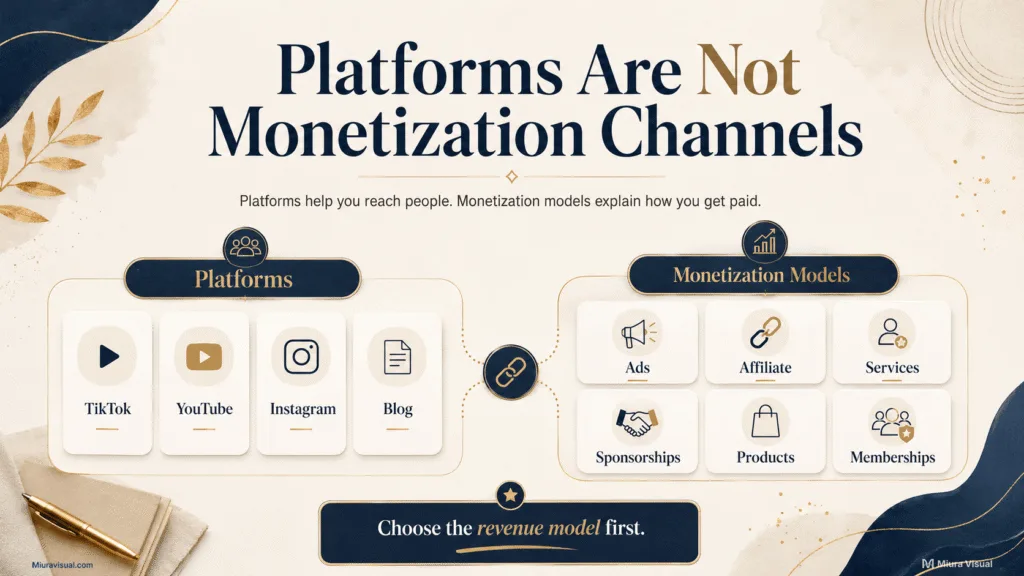
TikTok, YouTube and Instagram Are Platforms, Not Monetization Channels
TikTok, YouTube, Instagram and blogs are distribution platforms.
They help creators reach people and publish content.
Sponsors Affiliate marketing, advertising, sponsorships, services and selling your own products are monetization models.d posts or videos
They explain how money changes hands.
Confusing these two layers leads to poor decisions.
A creator might say, “I want to make money on TikTok.” TikTok offers various ways to earn:
- Product affiliate commissions
- Sponsored posts or videos
- UGC production for brands
- Live gifts or eligible platform rewards
- Leads for an external service or product
The same principle applies elsewhere:
| Platform | Possible monetization models |
|---|---|
| TikTok | Affiliate, UGC, sponsorships, product sales |
| YouTube | Advertising, affiliate, sponsorships, memberships |
| Brand partnerships, services, affiliate, products | |
| Blog | Advertising, affiliate, service leads, digital products |
This matters because a platform may generate strong reach without producing reliable revenue.
A viral TikTok video doesn’t guarantee sales.
In contrast, a smaller blog post with clear buying intent can bring in steady affiliate clicks.
Choose the revenue model first, then use the platform that supports it.
For example, creators producing long-form YouTube content and looking to make money on YouTube should check out YouTube monetization in Malaysia.
Short-form creators looking to make money on TikTok need to understand the available monetization options.
They can’t just rely on views to make money.
The Main Ways Content Creators Earn Money in Malaysia
Most creator income falls into seven practical categories.
| Income stream | Who pays | Audience needed | Speed to first income | Main limitation |
|---|---|---|---|---|
| Freelance services | Clients | Low | Fast | Income is tied to workload |
| UGC creation | Brands | Low | Fast to medium | Requires pitching and clear deliverables |
| Brand sponsorships | Brands | Medium to high | Medium | Campaigns can be inconsistent |
| Affiliate marketing | Shopee, Lazada or TikTok Shop | Low to medium | Medium | Clicks do not guarantee purchases |
| Platform advertising | Platforms | High traffic | Slow | Requires scale and eligibility |
| Digital products | Customers | Medium trust | Medium | High upfront creation effort |
| Memberships | Supporters | Loyal community | Slow | Requires ongoing delivery |
Freelance services
Creators can make money from photography, video production, editing, design, and content strategy.
They can do this even without a large audience.
This is often the most practical choice when cash flow matters now.
The trade-off is that income is linked to time, production capacity, and client demand.
Creators on this path should focus on a clear offer instead of trying to sell every skill.
A focused package is easier to price, explain and deliver.
👉 A deeper guide to freelance income for creators should handle pricing, scope and long-term positioning.
UGC creation
User-generated content, or UGC, refers to content made for a brand to publish on the brand’s own channels.
A creator doesn’t need a big personal following.
The brand values their content creation skills more than their audience size.
UGC is worth considering when you can:
- Present products naturally
- Follow a commercial brief
- Produce consistent short-form content
- Deliver clean footage and usable variations
It’s not a good fit if you don’t like revisions, scripted messages, or getting client approval.
Brand sponsorships
Brands may pay creators to show products, join events, or make content for their fans.
Sponsorships can bring in money faster than ads. However, they are often hard to predict at first.
Creators must also account for usage rights, revisions, exclusivity and payment terms.
Do not accept every collaboration simply because a product is free.
A relevant paid partnership can strengthen positioning.
An unrelated campaign may confuse the audience and reduce future trust.
👉 Creators aiming to negotiate campaigns should check the brand collaboration guide.
Affiliate marketing
Affiliate publishers earn a commission when someone purchases through a tracked marketplace or affiliate link.
Affiliate marketing works best when the content helps a reader make a decision.
Reviews, comparisons, tutorials, and problem-solving guides usually want to sell.
They focus more on sales than general lifestyle posts.
Test it when you create content about products, tools, or buying choices.
It’s a low priority if your audience mainly wants entertainment.
They rarely interact with your products.
👉 The full process belongs in the guide. Platform choices and expectations should also be included. This is important for affiliate marketing in Malaysia.
Platform advertising
YouTube and content sites can make money from ads.
They need to meet certain requirements and draw in enough visitors.
Advertising is attractive because older content may continue earning.
However, traffic comes first.
Ads on a small site or low-view channel won’t create real demand.
Advertising should be seen as a basic revenue layer, not the sole business model.
A blog can mix ads with affiliate content and service leads.
A YouTube channel can blend ads with sponsorships and products.
👉 For websites, the broader relationship between traffic, search intent and revenue is covered under blog monetization in Malaysia.
Digital products
Templates, presets, ebooks, online courses and paid resources can scale beyond one-to-one service work.
However, a digital product is not automatically easier than client work.
The creator should find a common problem, develop the product, show its value, and attract qualified traffic.
Create a digital product only when you have evidence that people want the outcome.
Repeated questions, service requests, and useful free resources can validate more than just follower count.
Memberships and fan support
Memberships succeed when people want ongoing access.
They also work for deeper learning or a sense of community.
A small engaged audience may outperform a much larger passive following.
However, recurring revenue creates recurring obligations.
Creators must continue providing the promised value even during slower creative periods.
Memberships won’t help creators who haven’t built trust or defined their content.
Monetization Readiness Matrix: Which Income Stream Fits You?
Use the following matrix to shortlist suitable options.
| Monetization method | Audience requirement | Income speed | Creator control | Scalability | Ongoing workload |
|---|---|---|---|---|---|
| Freelance services | Low | Fast | High | Low | High |
| UGC creation | Low | Fast to medium | Medium | Low to medium | High |
| Brand sponsorships | Medium | Medium | Medium | Medium | Medium to high |
| Affiliate marketing | Low to medium | Medium | Medium | Medium to high | Medium |
| Platform advertising | High traffic | Slow | Low | High | Medium |
| Digital products | Medium trust | Medium | High | High | Low to medium after launch |
| Memberships | Loyal audience | Slow | High | Medium | High |
Use the matrix as a filter, not a promise.
- Need income quickly? Prioritise services or UGC.
- Want greater scalability? Build affiliate content, advertising or products.
- Want more control? Avoid depending entirely on platform payouts.
- Have limited production time? Be careful with client work and memberships.
- Have no traffic or audience? Do not prioritise advertising.
A common beginner mistake is picking the highest-scalability option too soon.
You should first build the necessary conditions.
Digital products may scale well, but they will not sell without demand.
Advertising may become passive later, but it remains insignificant without traffic.
The best starting point is often the option closest to your current asset and a paying action.
Choose Your First Monetization Path Based on What You Already Have
Do not begin with the most popular platform.
Begin with your strongest existing asset.
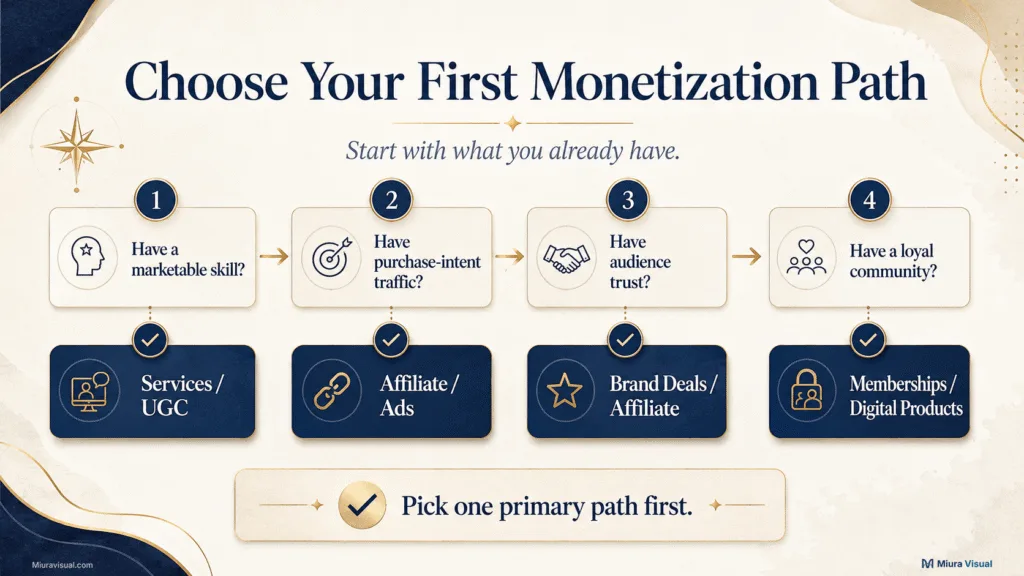
You have skills but no audience
Prioritise:
- Freelance services
- UGC creation
- Production support for other creators or businesses
A photographer, editor, or designer can sell their work right away, no need to wait for followers.
The creator still needs a portfolio and outreach, but not a large public platform.
Skip for now:
advertising and memberships.
Both require an audience asset that does not yet exist.
You have an audience that trusts you
Prioritise:
- Affiliate recommendations
- Relevant brand partnerships
- Small product tests
Trust is worth more than follower count.
This is true when your audience asks for recommendations.
They also value your process.
Before adding links, check whether followers show buying intent.
Questions in the comments section such as “Where did you buy this?” or “Which model should I choose?” are stronger signals than views alone.
❌ Avoid: promoting unrelated products only because the commission is attractive.
You have consistent search traffic
Prioritise:
- Display advertising
- Affiliate content
- Service leads
- Decision-stage articles
Search traffic is useful because readers often arrive with a clear problem.
However, not every keyword has commercial value.
A tutorial may attract many visitors but produce few purchases. A comparison troubleshooting article might get fewer readers. But it can increase affiliate clicks and inquiries.
For a small content website, focus on matching user intent. Don’t clutter every page with ads.
You have expertise but limited reach
Prioritise:
- Workshops
- Consulting
- Templates
- Niche digital products
- Premium services
Expertise can be monetised through a smaller number of higher-value transactions.
A creator doesn’t always need a huge audience.
Sometimes, the issue is specific but still valuable.
Start small with a paid service or workshop before building a large course.
The smaller offer tests whether people will pay for the result.
You have a loyal community
Prioritise:
- Memberships
- Exclusive learning
- Community access
- Recurring resources
A loyal community shows up repeatedly, asks deeper questions and values continued access.
Those signals matter more than viral reach.
Wait if members would only receive “more content.”
A recurring offer needs a clear ongoing benefit, not simply extra posts.
Three Realistic Monetization Stacks for Malaysian Creators
A creator does not need every income stream.
A useful stack combines methods that support one another.
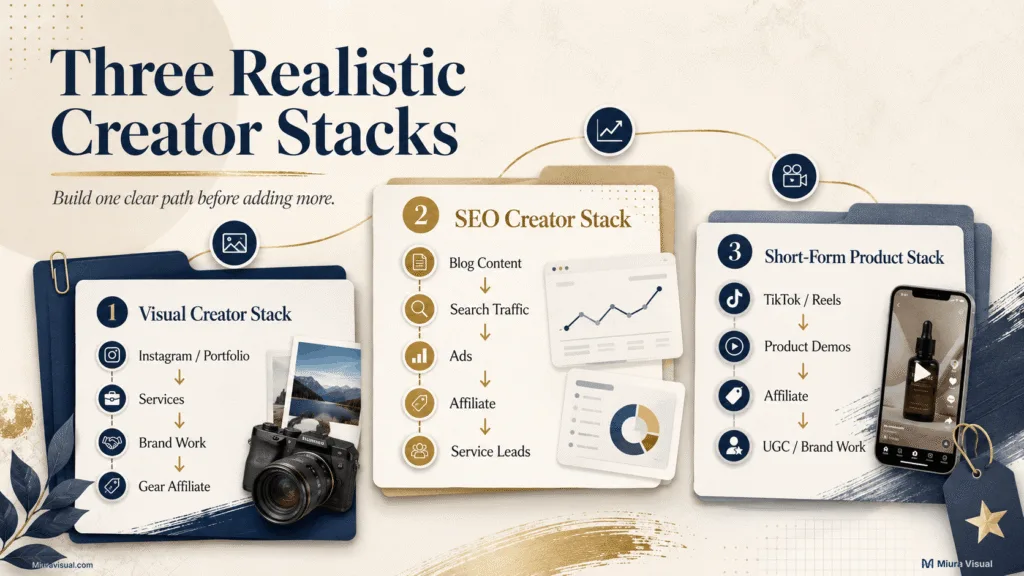
1. Visual Creator Stack
Instagram or portfolio → Photography or video service → Brand collaboration → Gear affiliate content
The service provides earlier cash flow.
Brand work adds commercial credibility.
Creators can add affiliate content later.
This works well when they often talk about tools, equipment, or workflows.
This stack suits photographers, videographers and visual creators who already have production skills.
The main risk is taking too much client work and leaving no time to build owned content.
Set a limit on project capacity so the short-term income does not consume the long-term asset.
2. SEO Creator Stack
Helpful blog content → Search traffic → Advertising → Affiliate content → Service leads
This stack is great for writers, educators, and small content sites. It helps them publish clear, structured problem-solving content.
Advertising sets a baseline. Affiliate articles and service pages focus on stronger commercial intent.
The system takes longer to build because rankings and topical authority develop gradually.
Miura Visual is building a similar setup.
Services meet short-term business needs.
Affiliate content acts as the middle layer.
SEO traffic provides long-term advertising and referral chances.
This is a working business structure, not a guaranteed income formula.
How Miura Visual Is Building This Stack
Miura Visual is creating this model by focusing away from a traffic-first approach.
Our first money-making assets were practical skills and services, not a big audience.
Photography, video production, and editing can create business opportunities.
This is true even without enough search traffic for ads or affiliate income.
We then added affiliate and referral content for more ways to make money.
At the same time, we developed SEO content to create a lasting source of traffic.
That’s why we see services, affiliate marketing, and advertising as working together.
They are not competing income streams.
They work at different stages.
Services can monetize an existing skill earlier.
Affiliate content needs relevant traffic and purchase intent.
Advertising becomes more meaningful only after the content itself attracts consistent traffic.
For Miura Visual, the goal is not to replace one income stream with another.
The goal is to build a system where short-term work and long-term content assets help each other.
3. Short-Form Product Creator Stack
TikTok or Reels → Product demonstration → Affiliate conversion → UGC or brand campaign
This stack suits creators who can produce frequent, clear product-led videos.
Short-form reach boosts discovery.
Affiliate links show if attention turns into sales.
Strong product communication may later attract UGC or campaign work.
The weakness is platform dependency.
If all traffic and sales rely on one algorithm, income may change quickly.
Repurpose useful content and build an additional searchable or owned channel where practical.
What Building Multiple Income Paths Has Taught Us
Making our mix of services, affiliate content, and search-led content has changed how we see creator earnings.
Now, we think differently about how creators make money.
Skills Can Monetize Before Traffic
One of the clearest lessons is that creators do not always need to build a large audience before earning.
If you have a useful skill, the quickest way to make money might be finding a client who needs it.
This is better than relying on an algorithm to share your content.
We prioritize a clear service offer over advertising when cash flow is urgent.
Attention Is Not the Same as Revenue
Affiliate content showed an important point.
Views, clicks, orders, and confirmed income are separate stages.
A piece of content can attract attention without creating buying intent.
A reader can click without buying, so an order might not get a valid commission.
We see monetization as a series of measurable actions.
More traffic doesn’t always mean more income.
Slower Assets Need a Different Expectation
Services can create an opportunity whenever a suitable client appears.
Search-led content works differently.
Articles may take time to rank, build traffic and generate commercial actions.
SEO and advertising may seem less helpful for quick income.
However, they can be valuable long-term assets.
We’ve learned to evaluate each income stream based on its purpose.
We shouldn’t expect all channels to generate revenue at the same pace.
Malaysia Reality Check: Revenue Is Not Always Cash
Creator activity can look successful while producing weak cash flow.
Keep these distinctions clear:
- Free products are not cash income.
- Gross revenue is not net profit.
- Views do not guarantee commercial action.
- Eligibility does not guarantee meaningful platform payouts.
- One campaign does not create stable monthly income.
A RM1,000 project may need transport, equipment, software, revisions, and a few days of work.
The real result depends on the remaining profit and the time required to deliver it.
Affiliate income also needs context.
Many clicks can lead to few sales if the product doesn’t match well, is too expensive, or is easy to compare with others.
Track creator income in separate categories:
| Category | What to record |
|---|---|
| Cash payments | Services, campaigns, sponsorships |
| Commission | Affiliate and performance-based earnings |
| Product value | Gifts or barter items |
| Expenses | Transport, tools, subscriptions, production |
| Net income | Cash revenue minus direct costs |
Avoid mixing gifted products with cash when checking if a monetization path can cover real costs.
Creators earning regularly should also keep proper payment, invoice and expense records. Platform dashboards alone are not a complete financial system.
What Our First AdSense Review Changed About Our Content Strategy
Our attempt to make money from ads revealed a problem.
We had a weak approach to content.
Earlier monetization articles explained platforms and programs.
They showed creators how to earn.
The information might still help, but you can find much of it online.
Our first AdSense review made that limitation more obvious.
Since then, we have been changing the role of Miura Visual Insights.
We want our articles to do more than just explain how a platform or monetization method works.
They should share what we learn while building the business.
This includes our workflows, decisions, tests, mistakes, and results when relevant.
That does not mean every article needs to become a case study.
Research is still useful when explaining rules, platforms and options.
The difference is that researched information should back the article.
It shouldn’t be the only reason the article exists.
For us, the stronger question is now:
What special insights can we share? What will a reader miss in the platform documentation?
That principle guides our work with affiliate marketing.
It also shapes SEO and creator monetization.
We use it for practical content at Miura Visual.
The 90-Day Monetization Framework We Would Use Today
We did not build every Miura Visual income stream through one fixed 90-day process.
Here’s the framework we’d use today for testing a new income path.
We based it on what we learned from service, affiliate, and search-led monetization.
The purpose of the 90 days is not to guarantee revenue.
The goal is to collect enough evidence.
This will help us decide if the monetization path needs more time, changes, or should be put aside.
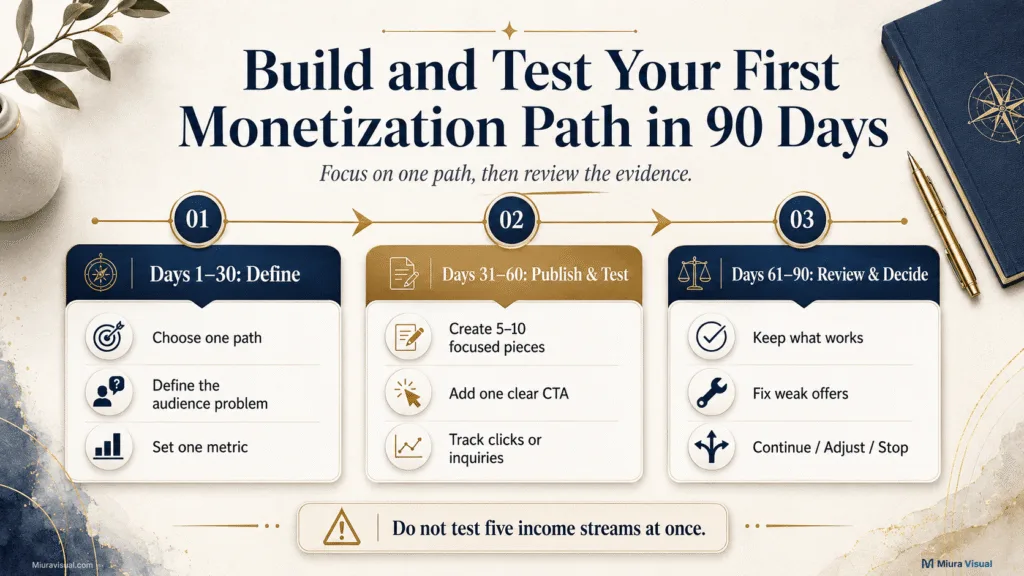
Days 1–30: Define the offer
- Choose one primary income stream.
- Define the audience problem it solves.
- Decide what action should create revenue.
- Choose one primary success metric.
Examples of measurable actions include:
- A service enquiry
- A booked consultation
- An affiliate click
- A confirmed sale
- A product waitlist signup
- A sponsorship enquiry
Do not use follower growth as the only metric.
Followers may support monetization, but they are not the commercial action itself.
Days 31–60: Publish and test
Create five to ten focused content pieces that support the selected revenue path.
For example:
- A photographer may publish portfolio breakdowns linked to a service page.
- An affiliate publisher may create product comparisons and buying guides.
- A UGC creator may publish sample product demonstrations.
- A digital product creator may test educational posts around one repeated problem.
Each content piece should have one clear next step.
Avoid sending readers to several unrelated offers.
Track:
- Content topic
- Platform
- Call to action
- Clicks
- Enquiries
- Orders
- Revenue
- Expenses
Days 61–90: Review the evidence
Ask:
- Which content attracted qualified action?
- Which offer caused confusion?
- Did people click but not buy?
- Did enquiries come from the intended audience?
- Was the workload reasonable?
- Is the result worth another 90 days?
Then choose one action:
- Continue when demand and delivery are both workable.
- Adjust when people show interest but do not convert.
- Stop when the offer receives no meaningful response after consistent testing.
- Expand only when the first path is stable enough to support a second stream.
A weak result does not always mean the platform failed.
The problem may be the offer, audience fit, content angle or call to action.
When You Should Wait Before Monetizing
Monetization should not always be the first priority.
Wait when you have no clear offer
Posting content and adding a payment link is not an offer.
First define one result you can help someone achieve.
Examples are: a finished photoshoot. A quicker editing workflow. A clearer product decision.
Wait when your topic changes constantly
Frequent topic changes weaken audience expectations and make commercial intent difficult to build.
Choose one repeatable problem area before adding affiliate links, products or memberships.
Wait when you cannot handle delivery
Don’t sell services, workshops, or memberships.
If you can’t manage communication, deadlines, and revisions, don’t offer them.
The better option is to build content and a waiting list until delivery capacity is ready.
Wait when you need immediate cash but chose a slow model
Advertising, SEO content and memberships may take time to become meaningful.
When you need quick income, focus on a service that sells well.
Build your slower asset on the side.
Wait when you are trying everything at once
Running a blog, YouTube channel, and TikTok account creates a lot of activity.
It also includes an affiliate system, membership, and digital products.
But this can lead to confusion.
There’s often no clear learning.
Select one primary path and one supporting platform.
Add another only after you understand what creates results.
Skip opportunities that damage audience trust
A paid offer is not automatically worth accepting.
Avoid products that don’t suit your audience.
Skip campaigns with unclear usage rights.
Don’t promote affiliate offers you can’t recommend responsibly.
Short-term income can weaken the trust required for future monetization.
Conclusion: Choose One Path and Validate It
The most important decision is not which platform is currently popular.
Identify the monetization path that best matches your skills, audience, traffic, or expertise.
Creators with a sellable skill should start testing an offer now.
Creators should wait if they lack a clear audience or commercial problem.
It’s better to focus on building a stronger content direction first.
If you need cash fast, focus on services.
Don’t rely on ads or memberships.
Pick one main income source.
Define a clear action you can measure.
Test it for 90 days.
Once you see real demand for that route, use the right platform or monetization guide.
This way, you can improve it without adding lots of new channels at once.
Frequently Asked Questions
Can content creators make money without a large following?
Yes. Freelance services and UGC depend more on production skill, reliability and portfolio quality than follower count. Affiliate income, advertising and sponsorships usually benefit more from audience reach or trust.
Should I start with services or affiliate marketing?
Choose services when you have a marketable skill and need faster income. Use affiliate marketing if you make product-related content and your audience wants to buy.
Can content creators earn passive income?
Most creator income is not fully passive. Advertising, affiliate articles, and digital products can keep earning after they’re published. But they still need traffic, updates, and maintenance.
When should I add a second income stream?
Add a second stream if the first one has a repeatable process, measurable demand, and a manageable workload. Adding another channel before that point usually creates more complexity than income.

Miura Visual
Transforming visuals into content, stories, and scalable value across platforms and audiences.
Related Article